
AI Must Not Merely Describe the Structure of the World—it Must Generate Concepts
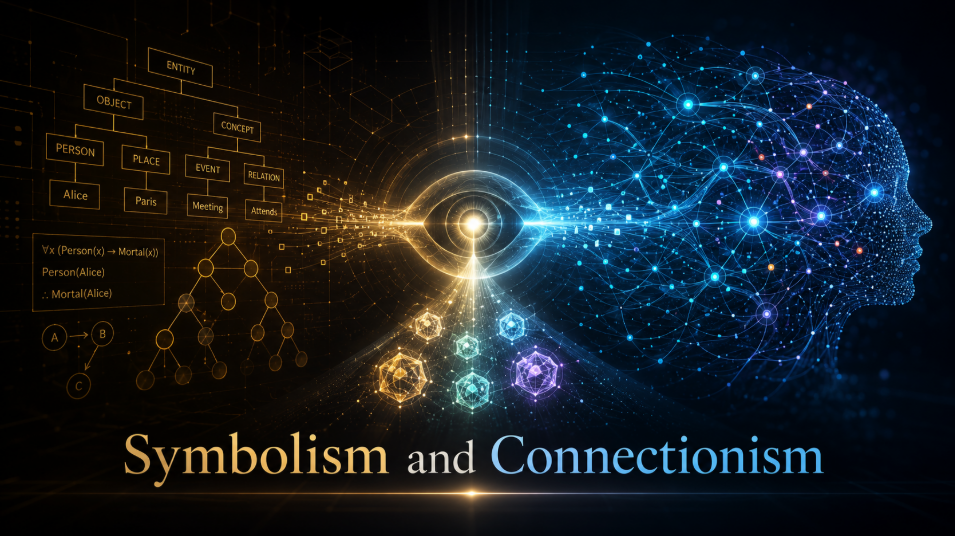
The history of artificial intelligence research can be understood, in broad terms, as a rivalry between two major approaches.
The first is symbolism, which attempts to represent knowledge through symbols and manipulate those symbols according to logical rules. The second is connectionism, which seeks to realize intelligent functions through learning and the interactions of large numbers of simple processing units.
Modern generative AI may appear to represent a victory for connectionism because it is based on neural networks. Yet when actual AI systems are built, symbolic frameworks such as databases, objects, classes, knowledge graphs, and ontologies are still widely used.
The central question, however, is not which approach is correct.
The more fundamental issue is this:
How do the concepts that make symbolic processing possible arise in the first place?
The Two Traditions That Shaped AI Research
Early AI research largely understood human intelligence as the ability to manipulate symbols.
The physical symbol system hypothesis, proposed by Allen Newell and Herbert Simon, argued that a physical system capable of appropriately manipulating symbols possesses the necessary and sufficient means for intelligent action.
Problem-solving, theorem proving, game playing, and natural-language understanding were therefore approached as processes of searching through and transforming symbolic representations.
From this perspective, the world contains objects and relations such as “human,” “company,” “product,” “contract,” “cause,” and “purpose.” If these could be translated into the correct symbols, a computer should, in principle, be able to reason about them in a manner comparable to a human being.
The difficulty was that it proved nearly impossible to convert all relevant knowledge about the real world into predefined symbols and rules.
As exceptions and contextual dependencies accumulated, rule systems became increasingly complicated. Constructing and maintaining knowledge bases required enormous human effort.
Connectionism took a different approach.
Rather than treating intelligence as a collection of explicitly written rules, it viewed intelligent behavior as emerging from the configuration of connections among many processing units. Artificial neural networks learn relationships between inputs and outputs by adjusting the weights of those connections.
Connectionism experienced a major revival in the 1980s and eventually developed into today’s deep learning and large language models.
Symbolism can therefore be described as an approach in which humans explicitly describe knowledge, whereas connectionism is an approach in which internal representations are learned from data.
Object-Oriented Models Are Not the World Itself
Symbolic thinking is deeply embedded not only in AI but also in software engineering.
In object-oriented programming, entities are defined as classes with attributes and methods. Inheritance, containment, and other relationships are then used to construct a model of a domain.
A company has employees. A customer places an order. An order contains products.
This is extremely effective when the objects involved in a business process are clearly defined.
However, an object-oriented model is not the structure of the world itself. It is a design created by humans for a particular purpose.
The same person may be represented as a “customer” in a sales system, a “patient” in a medical system, a “parent” in a school system, and a “resident” in a municipal system.
It makes little sense to ask which of these is the person’s true identity.
The class does not exist inside the individual. It is imposed according to the purpose of the system.
The same applies to ontologies.
In information science, an ontology is often defined as an explicit specification of a conceptualization. It formally describes which entities, concepts, properties, and relations are assumed to exist within a particular domain.
The important word here is conceptualization.
An ontology does not describe the world exactly as it exists independently of human cognition. It describes the conceptualization adopted by a particular community for a particular purpose.
An ontology can use concepts. It cannot, by itself, explain how concepts arise.
Concepts in Logic: Intension and Extension
In traditional logic, a concept is often explained in terms of intension and extension.
The intension of a concept consists of the properties or conditions that define it.
For example, the intension of the concept “bird” might include such properties as having feathers, laying eggs, and being a vertebrate.
The extension of the concept is the set of things to which it applies.
Sparrows, crows, penguins, and ostriches all belong to the extension of the concept “bird.”
In logic, the intension is generally understood to determine the extension. Yet two expressions may refer to the same object while conveying different meanings, which is why what an expression refers to must be distinguished from how it presents that object.
This framework is useful for organizing concepts, but it leaves an important question unanswered:
Who decides which properties should be included in the intension?
If a bird is defined as “something that flies,” penguins and ostriches are excluded.
If it is defined as “something that lays eggs,” insects and reptiles may also be included.
Defining birds as feathered animals works relatively well, but it was not the world itself that selected feathers as the decisive characteristic. Human classifiers treated that feature as important.
The intension of a concept is not automatically determined by observation alone.
What the Ugly Duckling Theorem Reveals
This problem is made particularly clear by Satosi Watanabe’s Ugly Duckling Theorem.
In simplified form, the theorem shows that if every logically possible property is treated equally, then any two distinct objects are equally similar.
Two swans may appear to share many properties. However, once arbitrary predicates are permitted, we can also count properties such as:
- being located on the left,
- being observed today,
- not being Swan A,
- being either Swan B or Duck C.
If every possible predicate is counted equally, a swan is no more similar to another swan than it is to the ugly duckling.
Classification therefore requires a bias regarding which characteristics matter and which can be ignored.
The Ugly Duckling Theorem demonstrates that similarity and classification are not simply objective structures already contained within the objects themselves. They depend on the selection and weighting of features.
Here, “bias” does not necessarily mean prejudice or error. It is closer to what machine learning calls an inductive bias.
No classifier can operate without making assumptions about what kinds of similarities matter.
Classification is therefore not merely the discovery of boundaries that already exist in the world.
It is the act of selecting characteristics that matter for a purpose and drawing boundaries accordingly.
Concepts Require Attention
How, then, is it decided which features matter?
The key is attention.
Human beings do not process every piece of sensory information with equal intensity. We direct attention toward certain aspects of our surroundings and allow others to recede into the background.
This distribution of attention depends on our goals, interests, expectations, past experiences, and perception of danger.
Research on human categorization similarly suggests that category learning involves directing selective attention toward relevant dimensions while ignoring irrelevant ones.
A botanist walking through a forest may attend to the shape of leaves and their veins.
A hunter may notice tracks, broken branches, and sounds.
A child may notice insects, berries, or unusual stones.
They are observing the same forest, yet they construct different conceptual worlds.
Attention is not merely the act of looking carefully at something.
It is the process that determines what should be treated as the same and what should be treated as different.
Attention assigns different weights to features. Those weights produce similarity. Similarity makes grouping possible. Through grouping, concepts arise.
Concepts therefore do not exist in the external world as finished objects waiting to be discovered.
Concepts Belong to Epistemology, Not Ontology
Ontology asks:
What exists?
Epistemology asks:
How do we know the world?
Traditional knowledge engineering has often attempted to describe the entities and relations that supposedly make up the world. This tendency is reflected in the very term “ontology.”
Yet when concepts are treated as if they were entities, we may begin to imagine that categories such as “company,” “customer,” “quality,” “risk,” “good,” and “evil” exist independently of human cognition.
In reality, concepts are better understood not as components of the world but as mechanisms through which an intelligent subject recognizes and acts within the world.
A living organism cannot examine every conceivable property of an object before deciding what to do.
It must quickly determine whether something is dangerous, edible, useful, familiar, hostile, or irrelevant.
Concepts compress enormous quantities of incoming information, connect new perceptions with past experience, and make rapid action possible.
To recognize something as a snake does not necessarily mean that the organism has discovered the metaphysical essence of “snake.”
It means that the organism has integrated shape, movement, pattern, and context into a category useful for immediate action, such as avoiding danger.
Concepts are the basis of symbolic processing. But concepts themselves are not fixed symbols.
Concept formation comes first. A name is assigned afterward.
AI Needs More Than the Ability to Manipulate Symbols
In symbolic AI, the meanings of symbols and the structure of categories are supplied in advance.
However, an autonomous AI operating in the real world must be able to generate concepts from input according to the purpose of the current situation.
Consider the concept of an “important customer.”
If current revenue is emphasized, the most important customer may be the largest buyer.
If future growth is emphasized, a small but rapidly expanding company may be considered more important.
If social influence matters, a well-known customer may take priority.
If the goal is to prevent churn, a dissatisfied customer may suddenly become the most important one.
The concept of an “important customer” has neither a fixed extension nor a fixed intension.
Its meaning changes according to the goal, time, and context.
If an AI system merely assigns customers to a predefined “important customer” class, it is automating an existing rule.
A genuinely intelligent system must understand the problem at hand, determine which characteristics deserve attention, and modify the way it classifies the situation.
Large Language Models Have Implicitly Learned the Human Conceptual World
On the surface, a large language model is a system that predicts the next token.
Yet to perform this prediction accurately, it must learn more than syntax.
It must acquire internal representations of word meanings, relations among entities, typical events, human value judgments, social institutions, and causal patterns.
The texts available on the internet contain traces of how human beings divide the world, which things they group together, what distinctions they consider important, and how they explain events.
Large language models learn not only explicit definitions of symbols but also the distribution of contexts in which those symbols are used.
As a result, semantic proximity, categories, relationships, and context-dependent meanings become encoded in continuous internal representations.
This does not necessarily mean that LLMs understand the world in exactly the same way humans do.
Their concepts are largely learned from language rather than from embodied perception and action. They may therefore differ significantly from humans in areas that depend strongly on sensory and motor experience.
Even so, by learning from vast quantities of human language, LLMs have formed an internal representation of the conceptual world and worldview embedded in human discourse.
This marks a decisive break from traditional symbolism.
Humans no longer need to design a complete ontology before the machine can work with concepts. The model can infer conceptual structures from patterns of language use.
Why Return to Ontology After Overcoming the Limits of Symbolism?
From this perspective, current approaches to retrieval-augmented generation present an interesting paradox.
RAG supplements the parametric knowledge of an LLM by retrieving external documents and supplying relevant passages during answer generation.
It is highly useful for accessing up-to-date information, citing sources, and incorporating organization-specific knowledge.
The problem is not RAG itself. The problem is how it is commonly implemented.
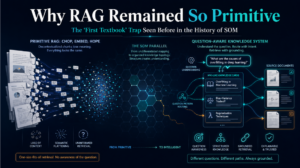
In a typical RAG system, documents are divided into chunks of a predetermined length. Each chunk is converted into an embedding vector, and fragments judged to be similar to a query are retrieved.
Yet these chunks are often no more than mechanically separated pieces of text.
Although an LLM is capable of generating flexible conceptual representations from context, the retrieval pipeline first reduces information to fixed fragments.
GraphRAG attempts to improve this by extracting entities and relations, constructing a knowledge graph, identifying communities, and generating summaries.
This can make large-scale relationships and global structures easier to retrieve than in simple chunk-based systems.
However, once information is decomposed into fixed entities and relations and represented as a graph, the system begins moving back toward the symbolic assumption that the world is fundamentally composed of identifiable objects and explicit relationships.
In reality, what counts as an entity, which relations matter, and what level of granularity should be used all depend on the question being asked.
The statement “Company A invested in Company B” may be important when examining ownership, but less important when investigating technology transfer, management influence, or supply-chain dependency.
A fixed graph cannot be the optimal conceptual structure for every possible question.
GraphRAG is more flexible than manually constructed ontologies. Yet if its generated graph is treated as the objective structure of knowledge, it risks returning to the same problems that constrained classical knowledge engineering.
RAG Is an External Memory, Not a Concept-Formation Mechanism
There is no need to reject RAG or GraphRAG.
They are useful technologies for narrowing the information an LLM should consult, providing evidence for answers, and building updateable forms of external memory.
What they should not be mistaken for is the structure of knowledge itself.
Chunks, entities, relations, graphs, and ontologies are all indexes for accessing information.
They can support concept formation, but they are not concept formation itself.
An intelligent AI system needs more than the ability to search within a fixed classification scheme.
It needs to:
- understand the current purpose,
- allocate attention according to that purpose,
- dynamically weight features in the input,
- reconstruct similarity and difference,
- generate concepts suited to the situation, and
- symbolize those concepts for reasoning and explanation.
Symbolic processing comes at the end.
Concept formation must come first.
The Real Question Is Not Symbols or Neural Networks
Symbolism is strong at explicit reasoning, formal rules, explanation, and verification.
Connectionism is strong at learning patterns from ambiguous inputs and developing flexible internal representations that change with context.
The future of AI does not require choosing one and discarding the other.
It requires a system in which neural networks generate concepts from input and those concepts are then symbolized when explicit reasoning, communication, or verification is needed.
This general direction is often described as neuro-symbolic AI.
Yet simply connecting a neural network to an ontology is not enough.
If the ontology remains fixed and externally supplied, then the concepts themselves are still being imposed from outside.
The central capability must be dynamic concept formation.
An intelligent system must be able to change what it attends to, what it treats as equivalent, and what distinctions it draws according to the goal and context.
Concepts Do Not Exist in the World; the World Appears Through Concepts
Human beings perceive the world through concepts.
But we should not confuse the conceptual world we experience with the world as it exists independently of us.
Concepts such as company, customer, market, competition, quality, danger, value, and justice do not exist in completed form without human beings.
They arise because humans must survive, act, cooperate, and make decisions. We direct attention toward certain aspects of the vast field of phenomena and treat them as meaningful units.
Concepts are not useless merely because they are not independently existing entities.
On the contrary, their lack of fixed existence is what makes them adaptable.
They can be revised, reconstructed, and replaced as circumstances change.
That flexibility lies at the heart of intelligence.
Traditional symbolism began symbolic reasoning by assuming that the relevant concepts had already been defined.
Connectionism partially overcame this limitation by learning internal representations from data.
Large language models learned the conceptual world embedded in human language on a massive scale and thereby acquired a degree of flexibility that purely symbolic systems could not achieve.
Yet when we apply these models to organizational knowledge, we often attempt to force information back into fixed objects, chunks, entities, relations, and ontologies.
The goal should not be to describe the world as one complete and permanent knowledge graph.
It should be to build AI that can change its attention according to purpose, generate concepts from input, and then use those concepts for symbolic judgment.
A concept is not a component of the world.
It is a unit of cognition created by an intelligent subject that must make decisions and act within a limited amount of time.