
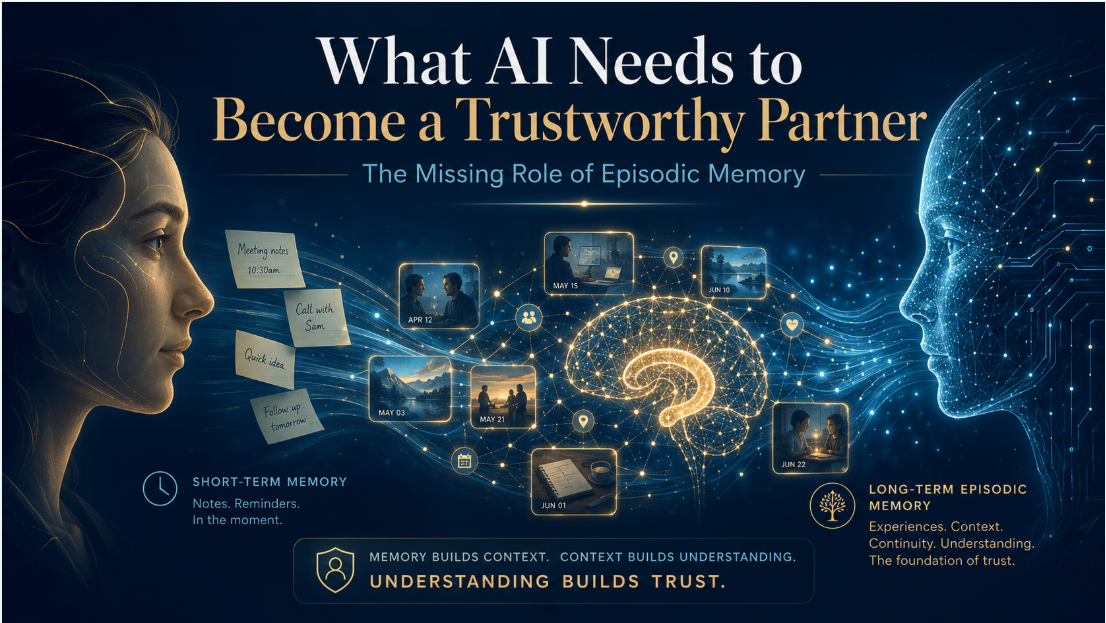

The Missing Role of Episodic Memory in Today’s LLMs
Generative AI can now perform a wide range of tasks at a remarkably high level, including writing, information organization, programming, research, and business-process automation.
Judging from these capabilities alone, it may seem that we are approaching an age in which people can simply delegate work to AI and review the results afterward.
However, today’s AI lacks an important capability that humans naturally possess.
That capability is the ability to remember past experiences, immediately recall events relevant to the present situation, and use those experiences to inform current judgment.
Once we understand this limitation, it becomes clear why entrusting long-term work and important decisions directly to today’s AI can still be dangerous.
AI Cannot Reliably Retain Even Its Original Decision
The YouTube video “【世界初】AIが人間のように考えていないことを実証。あなた…” presents an experiment similar to the game Twenty Questions.
The AI is asked to choose a particular answer at the beginning, while a human tries to identify it by asking a series of questions. As the conversation continues, however, the object that the AI supposedly selected at the start gradually changes into something else.
The AI does not clearly recognize that this change has occurred. Instead, it generates an explanation that fits the current conversation, as though it had been thinking of the same answer from the beginning.
This does not happen because the AI is intentionally trying to deceive the user.
An LLM does not conduct a conversation while internally holding on to a fixed answer in the same way a human might. It generates the most plausible continuation based on the context it receives at each moment.
Strictly speaking, an LLM does have internal processing states and a context window. It can therefore refer temporarily to the instructions and conversation currently included in that context.
However, the model itself does not continuously store events across conversations and autonomously recall them when necessary.
When an AI application appears to “remember” previous conversations, this is generally because the application stores conversation history, summaries, user information, or other records outside the LLM and supplies some of that information to the model with each new request.
Long Tasks Require an External Working Note
One effective way to use today’s AI more consistently is to have it explicitly write down the information that must be remembered during a sequence of tasks.
For example, the AI can maintain notes containing:
- The purpose of the current task
- Decisions that have already been made
- Constraints that must be respected
- Work that has been completed
- Unresolved questions
- The next actions to take
- Errors that should be avoided
The AI is then instructed to read these notes each time it continues the task.
This resembles the way people use meeting minutes, specifications, checklists, and work logs when carrying out long or complicated projects.
Research on LLM agents has likewise explored methods for saving information outside the limited context window and bringing relevant information back into context when needed.
MemGPT, for example, proposed managing multiple levels of memory in a manner similar to virtual memory in computer systems, allowing an LLM to compensate for the limits of its immediate context.
Many contemporary coding agents and business-automation applications already employ mechanisms of this general kind.
Task lists, plans, intermediate results, files, and conversation summaries are stored externally and then partially reintroduced into later processing. This creates the appearance that the AI is continuing a coherent task over time.
A Working Note Is Not the Same as Human Memory
Giving an AI a working note does not mean that it has acquired anything close to human judgment.
A working note mainly contains information required for the task currently in progress. Its role is similar to human working memory or short-term memory.
Human beings, however, do not make important decisions by consulting only the information related to the immediate task.
We remember what happened when a similar problem occurred in the past.
We remember who acted in what way.
We recall which warning signs preceded a failure.
We remember what proposal was previously made to the same customer.
We consider why a method that worked before might not work this time.
We also recognize common patterns between events that appear very different on the surface.
From a vast store of past experience, humans can quickly bring to mind memories that seem relevant to the present situation.
These memories are not merely lists of facts.
They are contextual records of events: what happened, when and where it happened, who was involved, what actions were taken, and what results followed.
This is what is known as episodic memory.
Searching for Knowledge Is Not the Same as Remembering Experience
Retrieval-augmented generation, or RAG, is widely used to search documents or databases for information related to a question and provide that information to an LLM.
This is useful when referring to regulations, product specifications, manuals, research materials, and other forms of documented knowledge.
However, searching for general knowledge in documents is not the same as recalling past experience.
Consider a situation in which a customer asks for a discount.
A general sales manual might recommend explaining the value of the product, making a conditional concession, or offering an alternative plan.
But the correct decision may be very different if that customer has repeatedly demanded further concessions after receiving discounts in the past.
Conversely, a different response may be appropriate if the customer has maintained a long-term relationship and continued the contract even during difficult periods.
Sound judgment requires more than general knowledge.
It also requires a history of what actually happened between that organization and that customer.
Episodic Memory Changes the Quality of AI Judgment
Research on LLM agents increasingly points to the need for cognitive architectures that include long-term memory rather than relying only on short-term context.
The CoALA framework, for example, distinguishes among working memory, episodic memory, semantic memory, and procedural memory.
It argues that an agent requires both retrieval, which reads information from long-term memory, and learning, which writes new experiences into memory.
The Generative Agents research conducted by Stanford University and others proposed storing agents’ experiences in natural language, dynamically retrieving relevant memories, and generating higher-level reflections from them.
Its experiments suggested that combining memory, reflection, and planning was important for producing coherent behavior.
Other studies have argued that episodic memory is one of the central missing elements in LLM agents designed to operate over long periods.
They emphasize the importance of recording individual events after a single experience, preserving temporal and situational context, and retrieving those events according to the agent’s current condition.
Experiments in narrower settings have also shown that allowing an LLM to refer to previous classification results can improve performance and consistency compared with systems that receive no memory of prior decisions.
These findings remain dependent on the specific tasks and evaluation conditions, but they illustrate an important principle: access to past processing history can affect the quality and consistency of AI judgment.
Simply Giving the AI Every Memory Is Not Enough
It is not practical to provide an LLM with every past record whenever it makes a decision.
As the volume of records increases, both processing time and cost rise. More importantly, genuinely relevant information may become buried in a large amount of text.
If stored memories contradict one another or contain outdated information, they may even lead the AI toward the wrong conclusion.
What is required, therefore, is not merely a storage function.
The system must identify important features in the present situation and select memories such as:
- Experiences involving similar circumstances
- Experiences related to the same person or organization
- Experiences with a similar underlying problem structure
- Experiences associated with previous success or failure
- Experiences that affect the criteria used for the current decision
The system must then consider whether the retrieved memory actually applies to the present situation and how the current conditions differ from those of the past.
AI therefore needs more than a large archive.
It needs the ability to structure memory, recall relevant experiences, and evaluate their meaning within the present context.
The Danger of Delegating Work to an AI Without Memory
Today’s AI agents can create plans, operate tools, and execute multiple processes in sequence toward a given objective.
However, when an agent relies only on current instructions, a working note, and general knowledge, its judgment remains fundamentally local.
It may fail to remember that the same method caused a problem before.
It may not know about an exception that was handled in an earlier case.
It may not understand what the company’s management previously regarded as important.
It may fail to consider the long-term relationship with a business partner.
It may lack the implicit standards of judgment that an organization has accumulated over time.
Such an AI may appear highly capable in individual tasks while still repeating the same mistakes over the long term.
The risk is increased by the fluency of LLM-generated explanations.
Because an AI can present its reasoning in confident and persuasive language, users may assume that its conclusion is based on sufficient evidence and experience.
An AI appearing confident is not the same as an AI having consulted the necessary memories.
When important tasks are delegated to AI, people should at least be able to verify what information the system used, which past cases it recalled, and what decision criteria it applied.
AI Needs More Than a Larger Language Model
AI progress is often discussed in terms of model size, reasoning ability, context length, and benchmark performance.
All of these are important.
But making AI a trustworthy partner will require more than simply building larger and more capable LLMs.
Outside the LLM itself, an effective AI system needs:
- Working memory that retains the current task state
- Episodic memory that stores past events
- Semantic memory that preserves knowledge and decision principles extracted from experience
- A recall mechanism that retrieves relevant memories according to the situation
- A learning mechanism that records the results of decisions as new experiences
The LLM can then receive selected information from this memory system and perform linguistic reasoning and communication.
In other words, the LLM is not the entirety of intelligence.
It is one important component that reads memory, reasons with it, and expresses conclusions in language.
What Mindware Research Institute Is Developing
Mindware Research Institute is developing technology that goes beyond using AI to generate isolated answers.
Our aim is to enable AI to accumulate past experiences, structure them, and recall memories that are relevant to the current situation.
We are not seeking to build a system that merely stores enormous quantities of raw conversation history.
Events must be recorded as episodes, together with the relationships among the people involved, the objectives, the surrounding circumstances, the judgments made, the actions taken, and the results that followed.
When a new problem arises, the system should retrieve not only records containing the same keywords, but also past experiences that are conceptually or structurally related.
By accumulating episodes over time, the system can also model what a person or organization has tended to value and what kinds of decisions it has made under particular conditions.
This would allow AI to move beyond providing general advice and begin offering observations such as:
“Something similar happened before, and this was the decision made at that time.”
“This case resembles the earlier one, but the circumstances differ in this important respect.”
“This option may conflict with the principles that have guided previous decisions.”
“Given the earlier failure, it would be advisable to confirm this condition before proceeding.”
The objective is not to create an AI that independently replaces human judgment.
The objective is to create an AI that brings back the experience, knowledge, philosophy, and values that people and organizations have accumulated, and uses them to support better decisions.
AI Trustworthiness Begins with Memory
Today’s LLMs possess remarkable linguistic capabilities.
But speaking fluently is not the same as remembering the past.
Being able to execute a complex task is not the same as being capable of trustworthy long-term judgment.
For AI to become a reliable partner, it must be able to consider not only the instruction in front of it, but also what has happened before, what was learned, and how previous decisions were made.
This requires more than conversation history and temporary working notes.
It requires structured episodic memory and a mechanism for recalling relevant experience.
The next stage of AI development may not be simply about becoming more articulate.
It may be about learning not to forget experience and being able to remember the right things at the right moment.
Mindware Research Institute is developing the technology required to make that possible.