
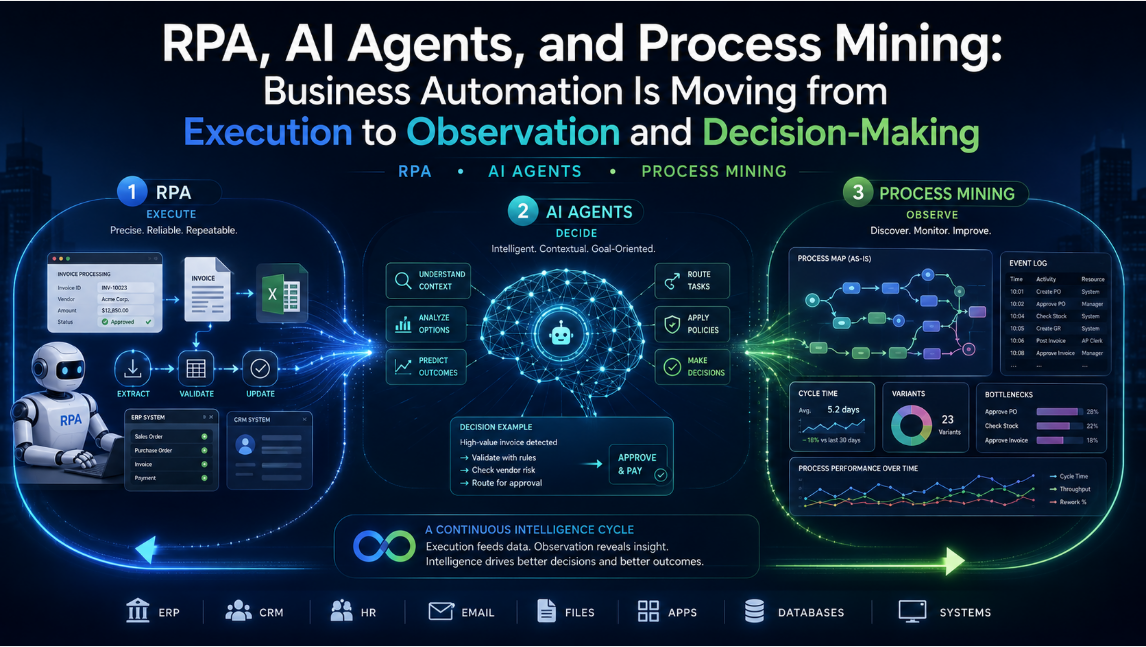

Discussions about business automation frequently refer to three technologies: robotic process automation, AI agents, and process mining. These are often introduced as separate categories, but in practice they are not competing technologies.
Their relationship can be summarized as follows:
- RPA reliably executes predefined procedures.
- AI agents interpret situations and select the next action.
- Process mining observes how work is actually performed.
In other words, RPA serves as the “hands and feet,” AI agents provide “judgment,” and process mining supplies “observation.” Business automation is now moving toward the integration of these three functions.
RPA Reproduces Human Computer Operations
RPA stands for Robotic Process Automation. It is a technology that uses software robots to automate repetitive operations that humans perform on computers.
Typical tasks include reading data from spreadsheets, entering information into business applications, saving email attachments, and transferring data between different systems.
RPA basically operates according to rules and procedures defined in advance by humans. UiPath similarly describes RPA as a technology that uses software robots to automate repetitive, rule-based tasks such as data entry and system integration. (uipath.com)
The strength of RPA lies in its accuracy and reproducibility. It can repeat the same procedure rapidly and consistently without fatigue or loss of concentration.
However, RPA does not understand the meaning of the work it performs. It may be able to copy a value from one screen to another, but it does not understand why the value is being entered or whether the current case should really be handled in the usual way.
RPA is therefore well suited to work in which procedures and decision conditions can be clearly defined. It is much less effective when the appropriate action changes depending on the situation.
The Fundamental Problem with RPA Is Not Exceptions but the Absence of Context
One of the most frequently cited weaknesses of RPA is its difficulty in handling exceptions.
Consider an automated invoice-processing system. In real business operations, the following situations may arise:
A supplier may have special contract terms. The invoice format may differ from the standard format. A transaction may require human review because of a previous dispute. The amount may be correct, but its relationship to the corresponding purchase order may be unclear.
From the system’s perspective, these are exceptions. From the employee’s perspective, however, they are part of ordinary business judgment.
The fundamental problem with RPA is therefore not simply that there are too many exceptions. More fundamentally, RPA does not possess the context or history surrounding each case.
Traditional RPA projects often begin by interviewing employees, creating a workflow diagram, and automating the resulting process. Yet people cannot necessarily verbalize every consideration involved in their decisions.
In actual work, employees implicitly take account of past experience, customer relationships, internal customs, the scale of potential risk, and other situational factors. When these elements are removed and only visible computer operations are automated, the system becomes unable to handle cases that fall outside the standard path.
There is another problem: existing work may simply be automated without being redesigned.
Processes that should be replaced by database integration or APIs are sometimes automated by making robots perform the same copying, pasting, and duplicate data entry previously carried out by humans. In such cases, the business process itself has not improved. An inefficient process has merely been accelerated.
Process Mining Shifted Attention from the Assumed Process to the Actual Process
Process mining emerged partly as a response to these limitations.
Traditional business analysis relied on asking employees to explain their work and then representing it in a flowchart. The process as described, however, does not necessarily match the process as actually performed.
Process mining analyzes event logs generated by enterprise resource planning systems, customer relationship management platforms, workflow systems, and other applications. It reconstructs the sequence in which activities actually occurred.
A typical event log records which activity was performed, for which case, and at what time. By arranging these events chronologically for each case, it becomes possible to visualize actual business paths. (processmining.org)
Microsoft describes process mining as a technology for understanding real organizational processes and identifying opportunities for improvement, automation, and digitalization. (learn.microsoft.com)
Process mining can reveal:
- Where work is delayed
- Where rework occurs
- How many paths differ from the standard process
- Which activities offer the greatest potential for automation
Process mining therefore discovers processes from actual operations rather than from idealized workflows designed in people’s minds.
For this reason, process mining is particularly valuable before an RPA implementation. Before automating a process, the organization first observes what is actually happening.
Process Mining Still Cannot Fully Explain Why a Decision Was Made
Process mining also has limitations.
Event logs primarily reveal what happened. They do not necessarily explain why a particular decision was made.
For example, process mining may detect that an application followed an unusual route. The event sequence alone cannot determine whether this resulted from an employee’s error, a special customer request, or a justified response to an earlier problem.
If every infrequent path is classified as an abnormality or inefficiency, important practical knowledge accumulated by employees may be lost.
After process mining has discovered the actual process, another mechanism is therefore required to interpret the context in which that process occurred.
This is where AI agents enter the picture.
AI Agents Make Decisions Outside Fixed Workflows
An AI agent is a software system that selects and performs actions based on a given objective and the information available to it. It may also use external tools and business systems to complete a task.
In traditional RPA, humans must define the sequence of operations in advance. An AI agent, by contrast, can read unstructured information such as documents and emails, interpret the situation, and decide—within a defined scope—what should happen next.
An AI agent might, for example, classify a customer inquiry, retrieve relevant information, draft a response, and escalate only high-risk cases to a human employee.
Automation Anywhere describes AI agents as systems capable of working not only with structured data but also with unstructured information such as documents, customer inquiries, and compliance materials, while making situation-dependent decisions and adjustments. (automationanywhere.com)
AI agents do not, however, completely replace RPA.
Their judgments are probabilistic. They may not always produce exactly the same result from the same input. Generative AI may also produce incorrect information or incomplete reasoning. Automation Anywhere’s documentation therefore warns that generative AI output should be reviewed for accuracy, reliability, and completeness. (docs.automationanywhere.com)
For operations that demand strict execution—such as entering financial values, transferring files, or registering data in a specified format—deterministic RPA may be more appropriate.
The relationship is therefore not a choice between AI agents and RPA.
AI agents decide; RPA executes.
UiPath also presents a division of labor in which AI agents handle tasks requiring reasoning and adaptation, while RPA handles structured, repetitive operations and reliable system interaction. (uipath.com)
The Three Technologies Form a Continuous Cycle
RPA, AI agents, and process mining can be understood as parts of a single operational cycle.
First, process mining observes the actual state of business operations.
Second, an AI agent interprets the current case and its surrounding conditions, then decides which action should be selected.
Third, RPA or an API executes the selected action accurately.
Fourth, the result is recorded as a new event log and once again becomes an input for process mining.
When this cycle functions effectively, business automation changes from a system that merely repeats a workflow created once into a system that continuously improves by observing actual operations.
Microsoft Power Automate, for example, combines desktop RPA, cloud workflows, AI, task mining, process mining, and orchestration within a broader automation platform. (microsoft.com)
UiPath and Automation Anywhere similarly emphasize agentic automation, in which AI agents, RPA, human judgment, and orchestration are integrated. (uipath.com)
At least at the level of current product strategy, this suggests that RPA is not disappearing. It is being repositioned as the execution layer within a larger automation architecture.
From Automation to Organizational Learning
Simply connecting an AI agent to RPA does not solve every problem.
When an AI agent handles each case independently, previous experience may not accumulate as organizational knowledge. Even when a similar failure occurs repeatedly, the experience may not necessarily influence future decisions.
What will be required in the next stage is not merely process automation, but a mechanism that remembers operational experience and forms judgment patterns from it.
Such a mechanism must preserve and connect:
- The context of the current case
- Similar incidents from the past
- The decisions made in those incidents
- Whether the outcomes were successful or unsuccessful
If process mining records what happened and an AI agent decides what should be done now, context memory and episodic memory support the question of which past experience should be applied to the present decision.
Without this memory layer, an AI agent may possess advanced language capabilities but still remain unable to inherit the organization’s own accumulated experience.
Conclusion
RPA is a technology for accurately performing repetitive computer operations according to procedures defined by humans. Its strength is reliability, but it does not understand context and has difficulty adapting to exceptional situations.
Process mining discovers actual business processes from event logs. It allows automation to begin from the work that is genuinely taking place rather than from an assumed process. Event logs alone, however, cannot fully explain why particular decisions were made.
AI agents interpret documents, conversations, and other information and select actions according to the situation. They can operate beyond fixed workflows, but their judgments involve uncertainty. Reliable execution and governance still require RPA, human approval, and auditable orchestration.
The relationship among the three technologies can therefore be expressed as follows:
Process mining observes reality, AI agents make decisions, and RPA executes them.
The next challenge is to add organizational memory and learning to this cycle.
The objective should not be merely to automate human computer operations. It should be to build a system that observes actual work, preserves exceptions as experience, forms judgment patterns appropriate to different situations, and continuously learns from results.
The next stage of business automation is not the replacement of RPA with AI.
It is the integration of RPA, AI agents, process mining, and organizational memory so that companies can observe, understand, and improve their own operations.