

Introduction
The emergence of large language models has fundamentally changed public perceptions of artificial intelligence. LLMs can perform question answering, writing, summarization, translation, information organization, programming, and many other tasks through a single natural-language interface—tasks that previously required separate software applications.
Because of this extraordinary versatility, a view has begun to spread that AI is essentially synonymous with LLMs, and that further progress in artificial intelligence will primarily result from making Transformer-based models larger and more sophisticated.
However, the ability to conduct natural conversations is not identical to the ability to perform real-world work continuously, reliably, and accountably.
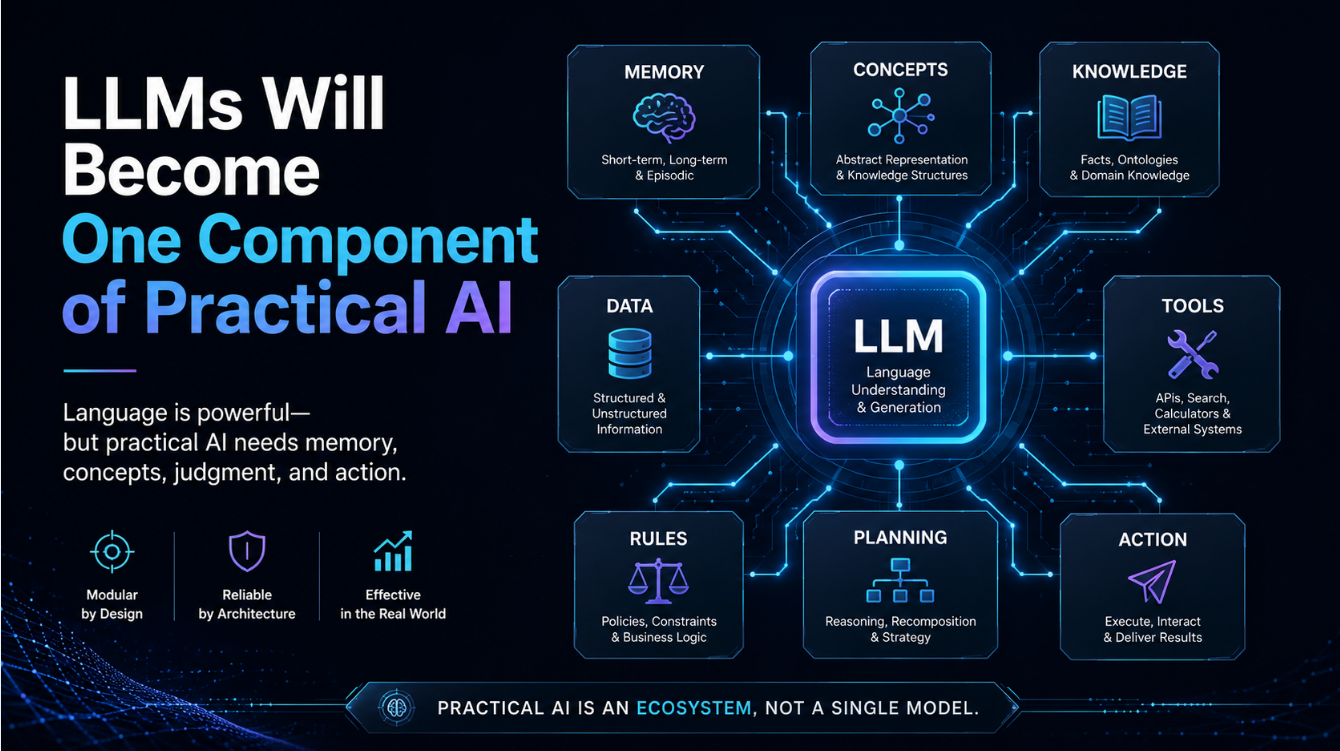
LLMs are powerful foundational technologies for handling language, general knowledge, and statistical patterns. Practical work, however, also requires persistent memory, organization-specific concepts, stable decision criteria, causal understanding, planning, execution, outcome evaluation, and connections to operational systems.
This article therefore advances the following proposition:
An LLM is not practical AI in itself. It will become one important component of a broader practical AI system.
Practical AI will require the integration of LLMs with multiple technologies based on different computational principles.
1. Distinguishing Conversational Ability from Operational Capability
When evaluating LLMs, it is necessary to distinguish conversational ability from the ability to perform work.
Conversational ability is the capacity to generate contextually appropriate responses to a given input. Contemporary LLMs demonstrate remarkable performance in this respect.
Operational capability, by contrast, is the capacity to understand a situation, obtain the necessary information, refer to prior experience and applicable rules, make a decision, act upon an external system, and record and evaluate the result in pursuit of a defined objective.
Consider an AI system used for customer service. Producing natural and helpful prose is not enough to complete the task. At a minimum, the system must be able to:
- identify the customer;
- verify contractual conditions;
- retrieve previous support records;
- obtain current product, inventory, and pricing information;
- comply with laws, internal rules, and authorization limits;
- escalate exceptional cases to the appropriate person;
- record the action taken; and
- preserve evidence for subsequent auditing and evaluation.
Practical work should therefore be understood as a continuous process consisting of:
situational assessment, information retrieval, memory access, decision-making, execution, recording, evaluation, and improvement.
An LLM can interpret information linguistically, generate possible responses, and mediate communication between humans and other systems. It cannot, by itself, constitute the entire operational process.
2. The Functions Best Performed by LLMs
The principal function of an LLM is to process information by exploiting the statistical structures of language and knowledge.
Its capabilities include:
- understanding and generating natural language;
- retaining and reconstructing general knowledge;
- selecting information according to context;
- comparing and summarizing multiple sources;
- generating text that resembles a reasoning process;
- converting unstructured information into structured representations; and
- mediating between human instructions and external systems.
These capabilities will be indispensable to practical AI.
Traditional business systems require users to learn how to operate menus, screens, search conditions, data-entry formats, and specialized commands. LLMs may reverse this relationship by allowing natural language to serve as the common interface.
Instead of requiring humans to adapt to the system, the system can interpret human language and translate it into the required operations.
In this sense, an LLM may become both the language-processing engine of practical AI and an integration interface connecting multiple specialized mechanisms.
Being an integration interface, however, is not the same as performing every function internally.
3. Functions That LLMs Alone Cannot Adequately Provide
3.1 Persistent Memory
An LLM normally generates responses from the context supplied at the time of interaction. It can refer to past information when that information is included in its context, but it does not necessarily possess an autonomous mechanism for deciding what should be retained, which events are important, or which prior experiences are relevant to a current problem.
In practical work, merely storing conversation histories is insufficient.
A useful memory system must relate events, decisions, reasons, actions, outcomes, successes, failures, and the conditions under which an experience may be reused. This requires an episodic memory mechanism distinct from ordinary conversational context.
3.2 Organization-Specific Concept Formation
LLMs learn concepts that are widely represented in public data. Organizations, however, develop their own systems of meaning.
Terms such as “important customer,” “critical failure,” “high-risk case,” and “quality problem” may be defined differently by different organizations.
Practical AI must not merely apply predefined categories. It must also be capable of forming organization-specific patterns and conceptual structures from accumulated data and experience.
3.3 Consistency of Judgment
LLMs can generate flexible responses adapted to changing contexts. This flexibility is valuable in conversation, but it can become a source of instability in operations that require strict and reproducible decisions.
Legal compliance, pricing, quality assessment, credit approval, and authorization processes often require the same conditions to produce the same result.
Practical AI therefore requires mechanisms for managing explicit rules, constraints, authorization structures, and decision criteria.
3.4 Causal Understanding
LLMs can learn relationships expressed in text and generate plausible causal explanations. Statistical association, however, is not equivalent to causation under intervention.
Real decisions require more than an account of what has occurred. They require predictions about what will happen when a particular condition or action is changed.
Causal models, world models, and simulations may therefore be needed to represent the relationship between actions and outcomes.
3.5 Connection to the External World
The internal parameters of an LLM do not directly represent current inventory levels, customer status, equipment conditions, financial data, email, calendars, or other real-time operational information.
Practical AI must connect to databases, enterprise applications, sensors, control systems, and communication tools.
It must also be able to perform updates, issue orders, send notifications, request approval, and carry out other actions safely and within defined authority limits.
3.6 Outcome Evaluation and Improvement
In practical work, the consequences of decisions and actions must be evaluated.
An organization must determine whether an AI-recommended measure was effective, whether a customer response was appropriate, and why a forecast failed. These results must then influence future decisions.
Without such a feedback cycle, an AI system may process tasks, but the organization cannot accumulate experience or systematically improve its behavior.
4. The Technological Components of Practical AI
Practical AI should be designed as a system in which multiple mechanisms perform different functions.
| Required function | Candidate technologies |
|---|---|
| Perception and input conversion | Transformers, image and speech recognition, multimodal models |
| Language understanding and generation | LLMs |
| Use of general knowledge | Foundation models, search systems, external knowledge sources |
| Concept formation and classification | SOM, GNG, clustering, self-organizing learning |
| Episodic memory | Event memory, temporal databases, hippocampal-inspired models |
| Semantic memory | Knowledge bases, knowledge graphs, document management |
| Similar-case retrieval | Embedding search, conceptual search, case-based reasoning |
| Causal analysis | Causal models, world models, simulation |
| Planning | Search algorithms, planners, workflows |
| Action selection | Reinforcement learning, policies, rule engines |
| Decision criteria | Constraints, value models, approval rules |
| Self-monitoring | Uncertainty estimation, metacognition, verification systems |
| External-system integration | APIs, MCP, databases, enterprise systems |
| Evaluation and improvement | Logs, audits, feedback learning |
This classification does not imply that each function must always be implemented as a separate software component. A single model may partially perform several of these functions.
The central point is that intelligence consists of qualitatively different functions, and it may not be rational to force every function into the same computational mechanism.
5. From Model Expansion to Functional Differentiation
Current AI development strongly favors incorporating as many capabilities as possible into a single large foundation model.
This approach has clear advantages. A common model can be used across multiple applications, while interfaces between separate functions can be simplified. As long as increased scale continues to produce substantial performance gains, consolidation within a single model remains a rational strategy.
As systems become more sophisticated, however, the need for functional differentiation is likely to grow.
A computer is not constructed by increasing one undifferentiated type of circuit without limit. CPUs, GPUs, memory, storage, communication devices, and sensors perform different roles according to their structural characteristics.
Practical AI may evolve in a similar manner. Language processing, memory, concept formation, planning, decision-making, execution, and verification may be assigned to different technologies according to their respective strengths.
The relevant question is therefore not whether LLMs or some alternative technology will prevail.
The relevant question is:
Which technology should perform each cognitive function, and how should those technologies be integrated?
Practical AI is fundamentally a systems-design problem.
6. The Continuing Relevance of Non-Deep-Learning Traditions
The success of generative AI has encouraged the impression that earlier approaches to artificial intelligence have become obsolete.
However, symbolic processing, expert systems, self-organizing learning, causal inference, and reinforcement learning were developed to address problems that differ from language generation.
Symbolic processing deals with explicit knowledge and the manipulation of rules.
Expert systems address specialist decision procedures and explainability.
Self-organizing learning forms structures and categories from data without requiring a teacher to define every classification in advance.
Causal inference examines changes produced by intervention rather than mere observational correlation.
Reinforcement learning improves action selection through interaction with an environment and evaluation of the resulting consequences.
These problems have not disappeared with the emergence of LLMs.
LLMs may instead make these technologies easier to integrate into practical systems by mediating between human language and specialized computational mechanisms.
An LLM should therefore not be regarded as the final technology that eliminates other branches of AI. It may be better understood as a common language layer that connects them.
7. Self-Organizing Learning and Concept Formation
The ability to form organization-specific concepts is particularly important for practical AI.
Organizations accumulate large volumes of experiential data, including customer inquiries, sales records, failure reports, free-text surveys, meeting minutes, and decision histories.
An LLM can summarize and explain individual documents. Structuring large numbers of experiences into organization-specific problem types, customer segments, and recurring decision patterns, however, is a different task from text generation.
Self-organizing methods such as the Self-Organizing Map and Growing Neural Gas form structures according to similarities among data points.
GNG, in particular, adds nodes according to the distribution of incoming data, forms connections between nearby nodes, and removes connections that are no longer used. It can therefore form categories from experience rather than forcing new data into a fixed classification system.
LLMs and self-organizing learning are not competing technologies.
A functional division of labor is possible:
- LLMs interpret and express information in language;
- self-organizing learning forms structures from accumulated experience;
- databases preserve factual records;
- rules constrain decisions; and
- workflows execute operational processes.
8. The Role and Limits of AI Agents
AI agents extend LLMs by enabling them to search, manipulate files, send messages, run programs, and perform multi-stage operations.
This is an important step in connecting conversational AI to practical work.
Agent capabilities, however, do not resolve every requirement of practical AI.
The ability to use tools does not imply the ability to maintain appropriate objectives, follow stable decision criteria, retrieve relevant experience, or learn from outcomes.
An agent is primarily an execution mechanism.
Practical AI additionally requires:
- objectives;
- memory;
- conceptual structures;
- decision criteria;
- authorization;
- auditability; and
- outcome evaluation.
The transition from chat systems to agents is therefore not, by itself, sufficient to complete practical AI.
9. Organization-Specific Cognitive Structures
General-purpose LLMs provide broad knowledge, but performing work within a particular organization requires a cognitive structure specific to that organization.
A cognitive structure is not merely a collection of internal documents. It includes questions such as:
- What constitutes an important customer?
- Which quality problems are considered critical?
- What is recognized as a risk?
- What decisions were made in the past?
- Under what conditions are exceptions permitted?
- Who possesses which authority?
- How is success defined?
Practical AI must relate data, experience, concepts, decisions, and outcomes rather than merely retrieve documents.
Because this cognitive structure differs between organizations, it cannot be fully supplied by a general-purpose foundation model.
10. The Division of Roles Between AI Platforms and User-Side Systems
AI platform providers will probably continue to supply LLMs, multimodal processing, general knowledge, tool-use capabilities, and agent execution environments as foundational services.
User organizations and specialized vendors, however, will still need to construct the layers that are specific to actual work.
| Platform layer | User or specialist-vendor layer |
| Language capability | Operational data |
| General knowledge | Organization-specific concepts |
| Image and audio understanding | Decision criteria |
| Coding capability | Business rules |
| General-purpose tool use | Authorization and approval structures |
| Agent execution infrastructure | Persistent memory |
| Basic search and connectivity | Integration with operational systems |
| General safety mechanisms | Outcome evaluation and continuous improvement |
This relationship resembles that between cloud platforms and enterprise systems.
Cloud providers supply computing resources and databases, but they do not directly design every organization’s operational system. Similarly, even highly capable AI platforms will not automatically complete the cognitive and operational structure of every organization.
11. Evaluation Criteria for Practical AI
Conversational AI is often evaluated by the fluency, informativeness, and clarity of its responses.
Practical AI requires different evaluation criteria.
It should be judged by whether it:
- reduces processing time;
- improves operational quality;
- increases consistency of judgment;
- reduces omissions and errors;
- uses past failures to prevent recurrence;
- makes the grounds for decisions traceable; and
- enables people to concentrate on work that genuinely requires human involvement.
The object of design is therefore not the model alone.
It is the entire operational process, including input, memory, judgment, execution, and evaluation.
12. The Next Axis of Competition
At present, competition in AI is centered on the performance of foundation models.
As practical adoption progresses, however, the primary competitive axis may shift from isolated model performance to the ability to integrate multiple technologies into effective systems.
Even when organizations use the same LLM, their results will differ according to:
- which data they provide;
- what they retain as memory;
- which conceptual structure they employ;
- which decision criteria they apply;
- which systems they connect; and
- which outcomes they evaluate.
As LLM capabilities become standardized and less expensive, the relative value of organization-specific memory, concepts, judgment structures, and operational integration may increase.
Conclusion
LLMs are extraordinarily powerful technologies for handling language, general knowledge, and information integration. They will undoubtedly play a central role in future practical AI systems.
They do not, however, constitute the whole of practical AI.
AI capable of performing real-world work requires more than language ability. It also requires:
- persistent memory;
- concept formation;
- semantic memory;
- causal understanding;
- planning;
- decision criteria;
- action;
- external-system integration;
- outcome evaluation; and
- continuous improvement.
It may not be optimal to embed every one of these functions within a single enormous model.
Just as electronic systems consist of multiple components based on different operating principles, practical AI is likely to consist of multiple technologies performing differentiated functions.
Within such a system, an LLM will serve as an important component that handles language and knowledge while connecting humans with specialized mechanisms and operational systems.
What has been created is not artificial intelligence in its entirety.
What has been created is an exceptionally powerful general-purpose component for handling human language and general knowledge.
The next challenge is not merely to make that component larger.
It is to integrate it with mechanisms for memory, concept formation, judgment, action, and evaluation, thereby constructing systems capable of performing practical work continuously and responsibly.
