
Introduction
Discussions of an AI bubble often revolve around a simple question: Is AI real, or is it fake? Yet this question misses the essential nature of a bubble.
The same confusion existed during the dot-com bubble around the year 2000. The internet itself was a genuine technological revolution. It did not disappear as a temporary fashion. It went on to transform communications, commerce, advertising, media, finance, public administration, and almost every other sphere of society.
Nevertheless, the dot-com bubble collapsed.
What collapsed was not the internet. What collapsed was the financial narrative that any company associated with the internet could justify a valuation far beyond its actual ability to generate profits.
The same distinction must be made in relation to AI.
Current AI systems still have major technical limitations. They remain weak in areas such as long-term memory, causal understanding, persistent interaction with the real world, and the interpretation of company-specific contexts. Even so, large language models have undoubtedly realized important parts of artificial intelligence, including natural-language interaction, text generation, information organization, translation, and programming assistance.
Therefore, even if the AI bubble collapses, this will not mean that AI technology was fraudulent or unreal.
A bubble does not describe the truth or falsity of a technology. It describes a financial phenomenon in which a genuine technological innovation is used to inflate share prices and corporate valuations beyond the level justified by actual earnings, creating a market in which participants seek to profit from rising asset prices.
What the dot-com bubble and the AI bubble appear to share is not the underlying technology, but this financial structure.
1. Technological Revolution and Financial Bubble Are Not Contradictory
Large technology bubbles are not necessarily built around technologies that do not exist. On the contrary, they are often built around genuine innovations with the potential to transform society.
A technology that nobody believes in cannot attract vast amounts of capital. Investors accept valuations far beyond current earnings precisely because some technical achievements have already been demonstrated and because a radically different future appears plausible.
The future value of a technological innovation is difficult to calculate. There is no definitive answer to how large a market may become, how much of an existing industry may be displaced, or how much profit may be generated ten years later.
This uncertainty creates room for expansive narratives.
During the dot-com bubble, the prediction that the internet would change the world was correct. However, the fact that the internet would change the world did not mean that every internet company listed at the time would become a highly profitable enterprise.
The same applies to AI.
AI is likely to transform industries and labor. But the growth of the AI market does not necessarily mean that every planned data center will be profitable, every AI company will produce sustainable earnings, or every current valuation can be maintained.
The long-term importance of a technology and the current price of a financial asset must be evaluated separately.
2. Cisco and NVIDIA: When Expectations Concentrate on Infrastructure Providers
Cisco Systems and NVIDIA symbolize an important similarity between the dot-com bubble and the AI bubble.
In the late 1990s, investors expected internet usage to grow rapidly. Capital therefore flowed into Cisco, a major supplier of routers and networking equipment. Even if it was impossible to know which internet companies would ultimately succeed, investors reasoned that every one of them would require network infrastructure. Investing in the supplier appeared safer than choosing among the service providers.
NVIDIA occupies a similar position today.
It may be unclear which generative AI services will become long-term winners, but large-scale AI development requires computing infrastructure. As a result, revenue and investor expectations have become concentrated in NVIDIA, the leading provider of GPUs and related AI systems.
Cisco in 2000 and NVIDIA today should not be treated as identical cases. NVIDIA already generates enormous revenue and profit, and its rise has a substantial operational foundation. At various points, its earnings multiple has also remained below the extreme levels reached by Cisco at the height of the dot-com bubble.
Nevertheless, the structural similarity is significant.
In both cases, investors have priced vast future demand into an infrastructure provider expected to benefit regardless of which downstream companies eventually win.
The argument that “whoever wins will still need this infrastructure” is persuasive. Yet infrastructure demand cannot exist indefinitely in isolation from the profitability of its users. If the companies purchasing the infrastructure cannot generate sufficient economic value, demand for that infrastructure must eventually weaken.
3. Fictional Transactions During the Dot-Com Era and Circular Transactions in the AI Industry
During the dot-com bubble, some internet startups engaged in reciprocal purchases of advertising inventory and services, allowing both sides to record revenue even when the underlying economic substance was limited.
Advertising swaps and barter arrangements could make businesses appear to be growing rapidly even when little or no meaningful cash changed hands. Some companies later restated their financial results after revenue had been recognized through transactions that overstated the scale of their business.
The transactions currently taking place among major AI companies should not be equated with such fictional transactions or accounting fraud.
Semiconductors, cloud computing capacity, data centers, and AI models are actually being supplied. Facilities are being constructed, GPUs are being delivered, and computing workloads are being performed. These are real transactions involving real assets and services.
However, there is still a structural similarity when the flow of funds is examined.
A semiconductor company may invest in an AI company, which then uses part of that investment to purchase its chips. A cloud provider may invest in an AI developer, which then signs a long-term contract to use that same provider’s cloud infrastructure. Investment, equipment purchases, cloud revenue, and rising corporate valuations may reinforce one another within a relatively limited group of companies.
These transactions are real and do not, by themselves, imply misconduct.
Nevertheless, when suppliers finance their customers and part of that funding returns to the suppliers through product purchases, it becomes difficult to distinguish independent external demand from demand created internally by investment within the industry.
If sales, order backlogs, capital expenditures, and valuations all rise simultaneously, the industry may appear to be generating substantial profits. Yet the purchasing companies are also accumulating costs, obligations, and future payment commitments.
For this reason, GPU sales and cloud contract values alone are insufficient to establish the economic independence of the market.
The more important questions are:
Where did the money originate?
Who will ultimately bear the cost?
Are the end users of AI generating benefits greater than the cost of the infrastructure?
Will the same level of demand continue if new investment capital becomes less available?
The existence of real transactions is not enough. The sustainability of final demand and the reality of investment returns must also be examined.
The fictional or inflated transactions seen during the dot-com era are legally and economically different from the real transactions among today’s major AI companies. However, both may create the appearance of a market growing more strongly than its independently generated end demand would support.
4. The “Engineered Bubble” and the Structure of an Asymmetrical Casino
A bubble is not always a purely spontaneous episode in which all market participants enter under equal conditions.
Startup founders, early investors, venture capital firms, investment banks, and large corporate partners can acquire shares much earlier than ordinary investors. They may also influence financing rounds, valuation narratives, media exposure, and the timing of a public offering.
When a company’s valuation rises, early shareholders can realize enormous gains by selling their shares. The buyers at the higher price are usually participants who entered the market later.
Within this structure, sustaining a high valuation until shares can be sold may sometimes become more important than building a business capable of generating durable long-term profits.
A vast future market is presented.
Exponential growth is forecast.
Fear of being left behind is encouraged.
Massive capital expenditure is offered as evidence of demand.
Investments, partnerships, and purchasing agreements are announced in ways that reinforce one another.
Once the valuation has risen sufficiently, early participants sell their shares.
Not all of these actions are illegal. Nor is it necessary to assume that a single group has secretly coordinated the entire market.
Each participant may simply be pursuing its own rational financial interest. Yet when those incentives point in the same direction, they can collectively create a structure that drives the market upward.
In this sense, an “engineered bubble” does not necessarily mean a conspiracy organized behind closed doors. It means that the institutions and reward systems of the capital market contain built-in incentives to raise valuations and allow early participants to realize gains before the underlying economics have been fully proven.
As a metaphor, the structure resembles a casino in which not every participant has the same odds.
Those who open the casino, determine the rules, enter at the lowest prices, and collect the stakes have an advantage. Those who arrive only after the excitement has reached its peak are more likely to finance the profits of those who entered earlier.
In this sense, a technology bubble can resemble a rigged gambling operation created to generate enormous profits for a limited group of participants.
The deception does not necessarily lie in the nonexistence of the technology. It lies in the conflation of the social value of a technology with the market price of financial assets, allowing future technological possibilities to be used as an almost unlimited justification for present valuations.
5. Why Data Mining Moved to the Foreground After the Dot-Com Bubble
The internet remained inside companies after the dot-com bubble collapsed.
The websites, e-commerce systems, customer-management systems, servers, and communications networks built during the bubble did not disappear. These systems continued to generate and accumulate large volumes of data, including purchasing histories, customer attributes, website traffic, inquiries, advertising responses, and clickstreams.
During the bubble, the central question had been:
How highly can an internet company be valued?
After the bubble collapsed, the question changed:
How can the information systems already constructed, and the data accumulated within them, be converted into business results?
This shift brought data warehouses, customer relationship management, business intelligence, statistical analysis, and data mining to the center of corporate IT.
Data mining was not suddenly invented after the collapse of the bubble. The research and commercial products already existed. Even around the year 2000, electronic commerce was being identified as a major application domain because it generated transaction records, customer events, and clickstream data on an unprecedented scale.
More precisely, the collapse of the dot-com bubble shifted attention away from simply building something on the internet and toward extracting value from the information produced by the internet.
The focus moved from constructing an information infrastructure to mining the information accumulated within that infrastructure.
6. What Will Remain After the AI Bubble
A similar transition is likely to occur if the AI bubble collapses or enters a major correction.
Today’s competition focuses primarily on the capabilities of AI suppliers: model size, GPU availability, data-center capacity, inference speed, and benchmark performance.
However, companies do not create business value merely by obtaining access to a more powerful general-purpose model.
Business operations depend on knowledge specific to each organization.
This includes not only official regulations and manuals, but also past proposals, meeting records, customer inquiries, complaints, exception handling, internal handovers, customer relationships, failed projects, decision criteria, and implicit priorities.
Much of this knowledge does not exist in an orderly database. It is dispersed across documents, email, chat systems, operational applications, and the memories of individual employees. The relationships among these sources are rarely made explicit.
LLMs have absorbed a vast amount of general linguistic and cultural knowledge. But they do not automatically know what a particular company prioritizes in a given situation, why it made a particular decision, or which exceptions it has historically accepted.
After the AI bubble, companies will no longer be able to focus only on the question of which AI model they should adopt.
They will instead have to ask:
Where is the knowledge that their AI systems are supposed to use?
What structure does that knowledge have?
Which parts are explicit, and which remain tacit?
This is where the next market will emerge.
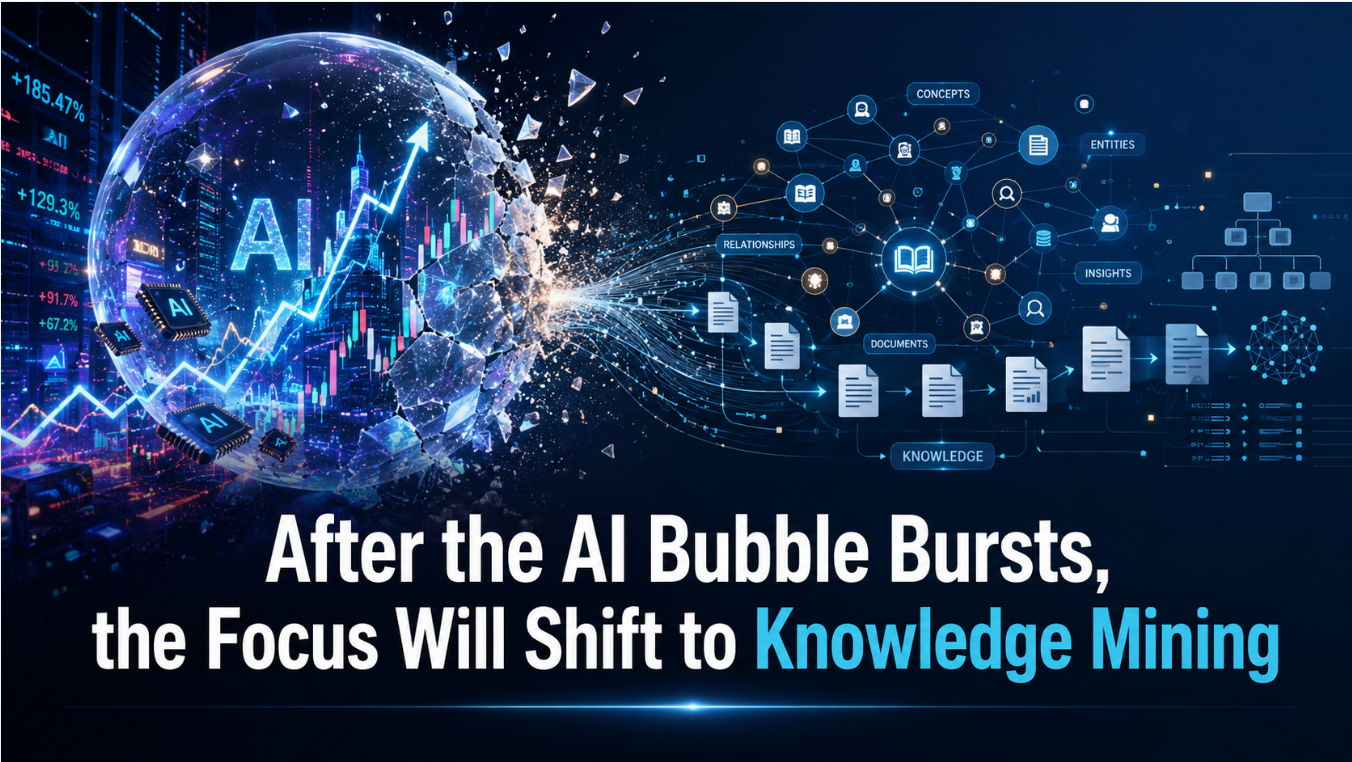
That market is knowledge mining.
7. AI Agents Belong Downstream of Knowledge Mining
AI agents are currently being promoted as the next major growth area.
Unlike ordinary chat systems, AI agents are expected to operate external tools, assemble multiple steps, and perform business tasks with a degree of autonomy.
However, this raises a serious question of sequence.
Before an agent is permitted to carry out business operations, the organization must make its own standards of correct judgment available in a form the agent can use.
The problem is that most companies do not possess a single, consistent, and fully documented body of operational knowledge. Rules differ between departments. Written procedures may conflict with actual practice. Exceptional cases may be more important than formal policies. Customer relationships may depend on information that has never been documented.
If AI agents are introduced before this knowledge is identified and organized, they will act on the basis of general knowledge, fragmented documents, or whatever information happens to be retrieved at a particular moment.
An agent may treat different departmental standards as if they were a single rule.
It may mistake a past exception for an official policy.
It may ignore unwritten commercial customs or customer relationships.
It may automate contradictory instructions without recognizing the contradiction.
If an organization contains ambiguous responsibilities and inconsistent procedures, an AI agent will not necessarily resolve them. It may instead execute those contradictions faster and on a larger scale.
Automation is not a technology for making an operation correct.
It is a technology for repeating an operation more quickly.
If the underlying process is wrong, automation accelerates the error.
Companies should therefore not begin by rushing to deploy autonomous agents.
They should first observe their operations, collect information, extract knowledge, structure that knowledge, and allow humans to validate it. Only then should agents be permitted to perform clearly limited tasks.
AI agents are not the starting point.
They are a downstream application built on top of a company-specific knowledge foundation created through knowledge mining.
8. What Is Knowledge Mining?
Knowledge mining is the process of extracting concepts, decision criteria, business processes, causal relationships, exceptions, problem structures, and practical rules from information dispersed throughout an organization, and transforming them into knowledge structures that both humans and AI systems can use.
Traditional data mining primarily analyzed numerical and categorical data in order to discover classification rules, correlations, segments, anomalies, and predictive patterns.
Knowledge mining addresses a broader range of organizational activity, including documents, conversations, operational events, decisions, and behavioral histories.
However, simply converting corporate documents into vectors and enabling similarity search is not enough.
Finding a document that contains certain words is not the same as understanding how an organization actually makes decisions and conducts its operations.
Organizations function through more than written rules. They rely on situational judgment, relationships between departments, exception handling, historical context, and patterns of success and failure.
What is required is not merely a system for storing information, but a system capable of forming conceptual structures from the relationships among those pieces of information and updating those structures as the organization changes.
After the AI bubble, the competitive question is likely to shift from:
Who uses the largest AI model?
to:
Who understands and can reuse its own organizational knowledge most effectively?
9. A Self-Organizing Operational World Model
For AI to use company-specific knowledge, organizations will require an internal model that goes beyond conventional document search.
Business operations do not follow fixed rules alone. The meaning of an event depends on customers, products, market conditions, personnel, timing, and historical context.
What is needed is a model that continuously represents the current state of an organization, the events occurring within it, and the patterns through which it has previously made decisions.
This may be called an Operational World Model.
An Operational World Model is not a universal model intended to reproduce the whole of physical reality. It is a model of the organization-specific world required for a particular enterprise to perform its operations.
Nor is it equivalent to a static ontology in which every concept, category, and relationship must be defined in advance by human designers.
Instead, documents, actions, decisions, and events generated inside the organization are continuously observed. Conceptual structures are then formed through patterns of similarity, proximity, co-occurrence, and temporal relationships. These structures are updated as the business environment changes.
Only when such a foundation exists can AI agents meaningfully refer to company-specific circumstances, draw on past experience, and support operations while explaining the basis of their judgments.
10. Mindware Research Institute’s Development Project
Mindware Research Institute is planning a development project titled:
Building a Self-Organizing Operational World Model Through Enterprise Knowledge Mining
The project aims to extract knowledge from documents, operational information, decision records, and events distributed throughout organizations.
Rather than forcing this information into a classification system defined in advance, the project will seek to develop a technological foundation through which company-specific conceptual structures can emerge through self-organization.
The immediate objective is not to deploy fully autonomous AI agents.
The first objective is to create a shared cognitive foundation through which humans and AI systems can develop a common understanding of an organization’s circumstances, experience, and decision criteria.
This foundation may then be extended to knowledge exploration, research, decision support, operational improvement, and, eventually, AI-agent integration.
Conclusion
The collapse of the dot-com bubble did not eliminate the internet.
What disappeared was the narrative that merely being an internet company guaranteed an ever-rising corporate valuation.
What remained was a vast body of data generated by the newly constructed internet infrastructure. Corporate attention then shifted from entering the internet economy to analyzing that data and converting it into business value. Data mining became an important practical discipline.
The collapse or correction of the AI bubble will not eliminate AI.
What may disappear is the narrative that companies can automatically improve productivity simply by adopting a powerful model and connecting AI agents to their systems.
What will remain is a more difficult and more fundamental problem.
What knowledge exists inside the company?
Where is that knowledge distributed?
What experiences produced its decision criteria?
Where do official rules differ from operational reality?
How should contradictory rules and exceptional cases be handled?
How can this knowledge be represented in a form that both humans and AI systems can share?
The next competition will not be a competition to adopt AI.
It will be a competition to become an organization capable of discovering, structuring, validating, and continuously updating its own knowledge.
Just as the center of corporate IT shifted from internet adoption to data mining after the dot-com bubble, the center of attention after the AI bubble is likely to shift from AI-model adoption to knowledge mining.
The decisive question will no longer be who possesses the greatest amount of computing power.
It will be who understands their own organization most deeply.