
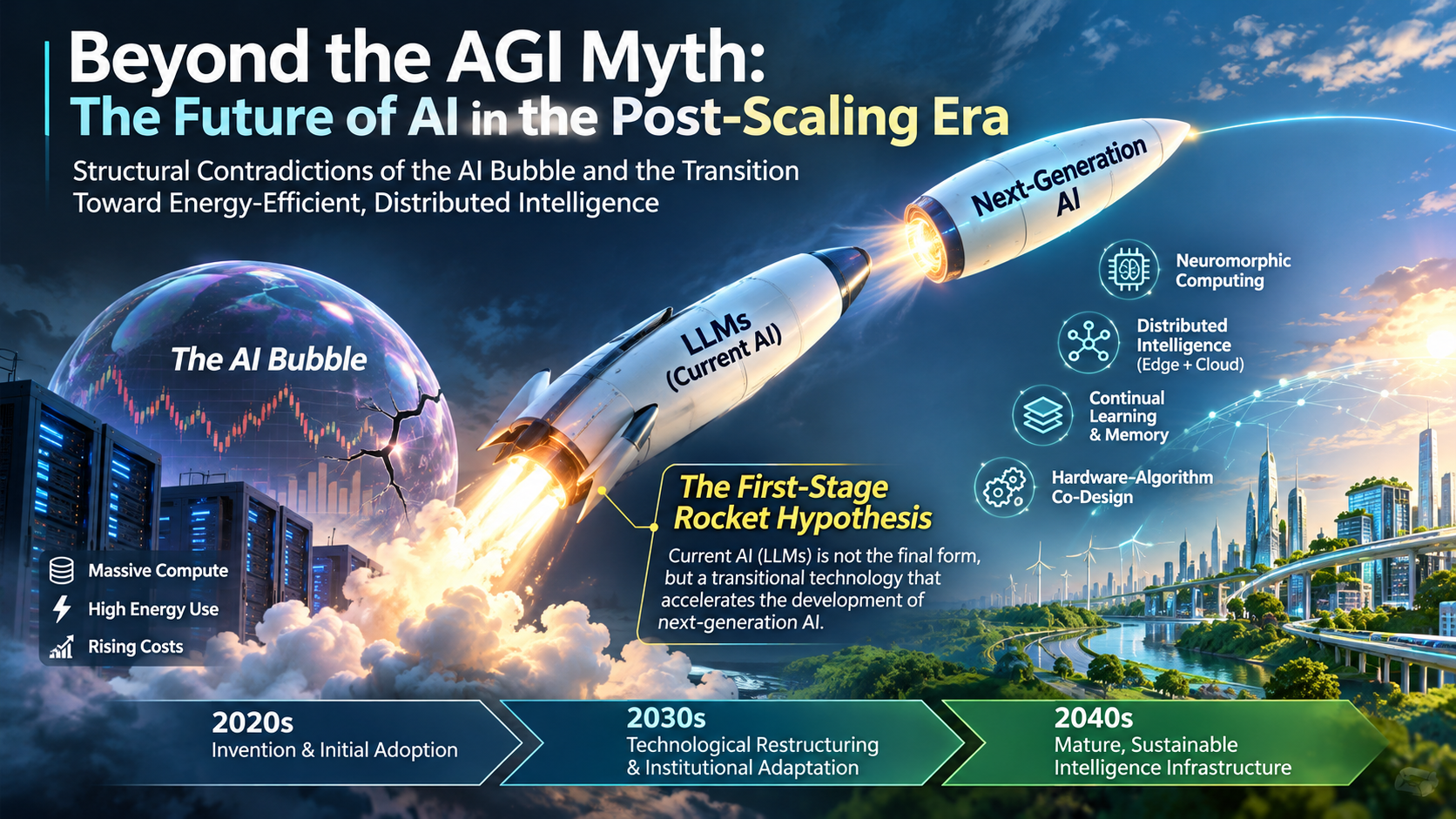

Structural Contradictions of the AI Bubble and the Transition Toward Energy-Efficient, Distributed Intelligence
November 12, 2026
Abstract
Since the emergence of ChatGPT in 2022, artificial intelligence has advanced rapidly, accompanied by increasingly ambitious predictions about the arrival of Artificial General Intelligence (AGI) around 2027 and the eventual emergence of superintelligence. At the same time, concerns about the risks associated with advanced AI have prompted calls for temporary pauses in development and stronger regulatory oversight.
However, these discussions contain a fundamental problem: they frequently assume that continued development of existing AI technologies will lead directly to AGI, without adequately examining the technical and economic contradictions inherent in the current development paradigm.
This paper argues that advances in large language models (LLMs) remain heavily dependent on the massive deployment of computational resources and training data, and that improvements in model capabilities do not necessarily imply progress toward sustainable, reliable, and genuinely general intelligence.
Furthermore, the enormous investments currently flowing into AI infrastructure may face a substantial correction as expectations of future returns diverge from economic realities. Such a correction would represent more than a financial event. It could expose structural limitations in the prevailing technological paradigm and accelerate a fundamental reorientation of AI research and development.
This paper proposes the hypothesis that contemporary AI should be understood not as the final form of artificial intelligence, but as a transitional technological platform—a “first-stage rocket” capable of accelerating the development of fundamentally different generations of AI.
Particular attention is given to neuromorphic computing, distributed intelligence, continual learning, associative memory, and hardware–algorithm co-design. The paper concludes by presenting a long-term scenario in which AI evolves through successive technological generations, potentially leading to a more mature and sustainable intelligence infrastructure during the 2030s and 2040s.
Keywords: Artificial General Intelligence, AI Bubble, Scaling Laws, Neuromorphic Computing, Edge AI, Continual Learning, AI for AI, Technological Paradigm
1. Introduction: The AI Revolution Has Only Just Begun
Throughout the history of technological innovation, considerable time has often elapsed between the emergence of a breakthrough technology and its establishment as a fundamental component of society.
Personal computers appeared during the 1970s, but it was not until the mid-1990s that they became widely accessible to businesses and households. During those two decades, technological progress involved much more than improvements in semiconductor performance. Operating systems, graphical user interfaces, networks, applications, and user capabilities evolved together.
A similar long-term evolutionary process may be necessary for artificial intelligence.
Admittedly, the initial adoption of contemporary AI has been considerably faster than that of personal computers. According to Stanford University’s AI Index Report 2026, generative AI reached an estimated population adoption rate of 53% within approximately three years of its emergence [1].
However, widespread experimentation with a technology is not equivalent to its complete integration into the economic and institutional foundations of society.
Organizations may adopt AI assistants for individual tasks while remaining far from redesigning their entire operations around autonomous or AI-supported processes.
It is therefore reasonable to distinguish between the initial diffusion of AI and the maturation of AI as a societal infrastructure.
One possible historical scenario is to interpret the 2020s as a period of invention and initial adoption, the 2030s as a period of technological restructuring and institutional adaptation, and the 2040s as a period in which mature intelligence infrastructures become widely established.
This scenario should not be understood as a deterministic technological forecast. Rather, it provides a historical framework for examining why the rapid emergence of powerful AI systems does not necessarily imply the imminent completion of the AI revolution.
2. The AGI Narrative and the Contradictions of Contemporary AI Development
2.1 Scaling-Based Performance Improvements Versus Qualitative Advances in Intelligence
The dominant characteristic of contemporary frontier AI development is its reliance on increasing quantities of training data, computational resources, model parameters, and, more recently, inference-time computation.
In October 2026, Mertens and colleagues reported an analysis of 809 language models released between 2022 and 2025, finding that differences in training compute could explain approximately 80–90% of the performance variation among frontier models [2].
This suggests that the scale of computational investment remains a decisive factor in contemporary AI competition.
However, dependence on scaling does not directly imply that progress in algorithms has ceased. Improvements in training methods, reasoning techniques, model architectures, and computational efficiency continue to contribute to AI development.
The more fundamental question concerns the relationship between increasing resource requirements and the practical value obtained from additional computational investment.
Current AI systems demonstrate remarkable capabilities in mathematics, programming, scientific problem-solving, and numerous other intellectual tasks.
Nevertheless, they continue to face significant limitations in robustness, continual learning, persistent memory formation, long-term autonomous behavior, and the verification of generated conclusions.
For example, research published in 2026 on the reliability of AI agents found that improvements in conventional capability benchmarks have not been accompanied by equally substantial improvements in consistency, robustness, predictability, and safety [3].
This does not mean that recent advances in AI are illusory.
Rather, it reveals an important structural contradiction:
The development of increasingly powerful AI capabilities and the maturation of reliable, economically sustainable autonomous systems are progressing at different rates.
The distinction between these two forms of progress is essential for understanding the future of AI.
2.2 The Conceptual Ambiguity of AGI
There is no universally accepted operational definition of Artificial General Intelligence.
In some discussions, AGI refers to systems capable of performing a broad range of intellectual activities at approximately human levels. In others, it refers to systems capable of carrying out most economically valuable cognitive work.
These definitions are not equivalent.
A model may achieve exceptional performance on demanding scientific or mathematical benchmarks without demonstrating reliable long-term autonomy in unpredictable environments.
Similarly, the ability to generate sophisticated answers does not necessarily imply the ability to accumulate experience, reorganize knowledge independently, or maintain coherent behavior over extended periods.
The ambiguity surrounding AGI allows improvements in specific benchmarks to be interpreted as evidence that general intelligence is approaching.
Predictions that AGI will emerge in 2027 should therefore be evaluated with particular care.
Without clearly defined criteria for intelligence, autonomy, learning, reliability, and generalization, such predictions remain speculative technological scenarios rather than rigorously testable forecasts.
2.3 The Political Economy of AGI and AI Development Moratorium Narratives
Predictions of imminent superintelligence and demands for restrictions on advanced AI development appear, at first glance, to represent opposing perspectives.
Yet both may share an important underlying assumption: that contemporary AI is rapidly approaching a form of intelligence powerful enough to fundamentally transform human civilization.
This common assumption gives the AGI narrative potential economic and political functions beyond its scientific significance.
Claims that AGI is imminent may support expectations of extraordinary future economic returns, thereby helping to justify massive investments in AI infrastructure and unusually high corporate valuations.
Conversely, warnings about catastrophic risks from advanced AI can encourage stronger regulation and oversight. While such concerns may be legitimate, regulatory frameworks could also reinforce the position of organizations possessing the financial and technical resources necessary to meet demanding compliance requirements.
This does not establish that AGI forecasts or calls for development pauses are deliberate misinformation.
Researchers have raised substantive concerns about AI safety, and the 2023 open letter organized by the Future of Life Institute called not only for a temporary pause in certain AI development activities but also for stronger research into safety and reliability [4].
The critical issue is not simply whether these warnings are sincere or scientifically justified.
It is whether the concentration of public attention on hypothetical future superintelligence diverts attention from the immediate technical and economic contradictions of existing AI systems.
Debates about AGI should therefore distinguish among three different questions:
- What can current AI systems demonstrably accomplish?
- What future capabilities can reasonably be inferred from existing technical evidence?
- How do economic and political incentives influence public interpretations of these developments?
Without this distinction, discussions of AGI risk becoming narratives that obscure rather than clarify the actual trajectory of AI technology.
3. The AI Bubble: A Divergence Between Technological Progress and Economic Sustainability
The extraordinary level of investment in contemporary AI infrastructure is based on expectations of substantial future growth in demand, productivity, and revenue.
According to the International Energy Agency’s April 2026 report, capital expenditures by major technology companies exceeded $400 billion in 2025 and were expected to increase substantially again in 2026.
The same report projected that global data-center electricity consumption could increase from approximately 485 TWh in 2025 to around 950 TWh by 2030 [5].
These figures demonstrate that contemporary AI development depends not only on advances in machine learning but also on electricity generation, transmission infrastructure, cooling systems, semiconductor manufacturing capacity, and access to financial capital.
Even if future models achieve substantial performance improvements, the current development model may prove economically unsustainable if the resulting commercial value fails to justify the required capital investment.
At least three structural contradictions can be identified.
First, there is a divergence between AI capabilities and operational reliability.
A system may solve highly complex problems while still requiring substantial human supervision because its outputs cannot be consistently trusted.
In such cases, the costs of verification, monitoring, correction, and liability management may significantly reduce the economic benefits of automation.
Second, there is a divergence between computational investment and economic returns.
If the additional value generated by model improvements grows more slowly than the costs of training, infrastructure depreciation, electricity, and operation, technological progress will not necessarily translate into sustainable profitability.
Third, there is a divergence between the speed of AI development and the capacity of organizations and institutions to adapt.
Businesses operate within established processes, information systems, legal responsibilities, regulatory frameworks, and organizational cultures.
Even when AI technologies become technically capable of performing certain tasks, the transformation of these surrounding systems may require considerable time and investment.
A major decline in financial expectations could therefore trigger a chain reaction involving reduced infrastructure investment, tighter financing conditions, the cancellation of development programs, and the consolidation or failure of AI startups.
However, an AI bubble collapse is not inevitable.
If AI-related revenues grow rapidly enough, or if improvements in computational efficiency sufficiently reduce operating costs, the industry may continue to expand without a severe financial disruption.
The central point is not that a collapse must occur.
Rather, the prevailing model of AI development, centered on ever-larger computational investments, will increasingly be judged according to its economic sustainability.
A major market correction would make this contradiction particularly visible and could accelerate changes in the technological priorities of the AI industry.
4. The Post-Scaling Transition: From Larger Models to More Efficient Intelligence
If the AI industry undergoes a substantial investment correction, the central objective of technological development may shift.
Instead of asking how to maximize performance on increasingly demanding benchmarks, researchers and developers may place greater emphasis on how to implement reliable, adaptive intelligence using fewer computational and energy resources.
This transformation would involve more than reducing model sizes.
It would require reconsidering how intelligent functions are organized and implemented.
4.1 From Monolithic Models to Functionally Specialized Intelligence
Contemporary LLMs integrate many different capabilities—including language processing, knowledge representation, reasoning, and text generation—within a large neural network.
However, using the same enormous model for every cognitive task may not be the most efficient architecture.
Future AI systems may increasingly separate functions such as perception, memory, reasoning, planning, verification, and action.
These functions could be implemented using different computational mechanisms and integrated according to the requirements of particular applications.
Small language models, structured knowledge bases, specialized reasoning engines, retrieval systems, and adaptive memory mechanisms could each perform distinct roles.
Such systems would resemble a functional architecture of intelligence rather than a single universal model.
4.2 From Centralized Cloud AI to Distributed and Hierarchical Intelligence
Contemporary frontier AI relies heavily on centralized data centers for training and inference.
However, applications requiring continuous interaction with the physical environment—including industrial automation, robotics, vehicles, medical equipment, and personal devices—do not necessarily benefit from routing every computation through distant cloud infrastructure.
Latency, privacy, connectivity, resilience, and operating costs may favor local execution.
Consequently, edge AI, local inference, quantization, model distillation, and on-device learning are likely to become increasingly important.
Nevertheless, distributed AI is not automatically more energy-efficient.
Duplicating computation across large numbers of devices can increase total energy consumption, even if individual devices operate efficiently.
The more plausible long-term architecture is therefore not the complete replacement of centralized AI but a hierarchical distribution of intelligent functions among cloud systems, local servers, and edge devices.
In such a system, computational tasks would be allocated according to their requirements for complexity, latency, privacy, energy efficiency, and reliability.
4.3 From Static Pretrained Models to Continual Learning and Memory Formation
Current LLMs acquire extensive knowledge through pretraining, but continuously incorporating new experiences into their parameters remains computationally expensive and technically challenging.
Biological intelligence, by contrast, depends on the accumulation of experience, the modification of internal representations, and ongoing adaptation to changing environments.
Future AI architectures may therefore increasingly rely on explicit mechanisms for experience storage, associative retrieval, structured conceptual representations, and localized learning.
Rather than attempting to encode every new experience within the parameters of a giant neural network, an intelligent system could combine a relatively stable computational model with dynamically evolving memory structures.
This would also change the criteria by which intelligence is evaluated.
Instead of focusing primarily on the quantity of knowledge acquired during pretraining, researchers would examine how effectively a system acquires new experiences, preserves them, reorganizes them, and applies them to unfamiliar situations.
The ability to learn continuously without repeatedly retraining an enormous model could become one of the defining characteristics of the next generation of AI.
5. Neuromorphic Computing as a Candidate for the Next Technological Generation
Neuromorphic computing represents one of the most promising approaches to fundamentally different AI architectures.
Conventional deep learning relies heavily on matrix operations and frequent movement of data between processing units and memory.
Neuromorphic architectures seek to improve computational efficiency through mechanisms inspired by biological nervous systems, including event-driven processing, massively parallel computation, sparse activation, and the close integration of memory and computation.
Spiking neural networks (SNNs), in particular, process information through discrete events rather than continuously updating every computational element.
This approach can be highly efficient in applications involving sparse sensory information, real-time perception, and event-based control.
In 2024, Intel introduced Hala Point, a research system supporting up to 1.15 billion artificial neurons, demonstrating the possibility of developing neuromorphic systems at substantial scale [6].
However, the existence of such hardware does not establish that neuromorphic computing can already replace contemporary LLMs or provide the foundations of general intelligence.
Significant challenges remain in learning algorithms, long-term memory, inter-chip communication, analog device variability, software development environments, and compatibility with existing machine-learning frameworks.
Moreover, improvements in energy efficiency alone are insufficient to create general intelligence.
A viable architecture must also support memory formation, reasoning, learning, adaptation, and coordination among different cognitive functions.
For these reasons, neuromorphic computing should not yet be regarded as the inevitable successor to GPU-based AI.
It will compete and potentially converge with other approaches, including low-precision computation, sparse processing, in-memory computing, and specialized accelerators.
The significance of neuromorphic computing lies in its departure from the assumption that greater intelligence must primarily be achieved by making existing neural networks larger.
The next major breakthrough may come not from increasing the size of AI models, but from designing computational structures better suited to the functions of intelligence itself.
6. Using AI to Develop the Next Generation of AI: The First-Stage Rocket Hypothesis
A useful way to understand the historical role of contemporary AI is through the analogy of a multistage rocket.
The first stage consumes enormous amounts of fuel to accelerate the vehicle, but its purpose is not to continue operating indefinitely.
Its role is to propel the next stage into a position from which further progress becomes possible.
Contemporary LLMs may occupy a similar position in the technological evolution of artificial intelligence.
They require massive computational infrastructure and substantial energy resources. They remain imperfect in reliability and autonomy, and their current architectures may not provide the most efficient foundations for future intelligent systems.
Nevertheless, they already possess valuable capabilities in software development, scientific literature analysis, mathematical exploration, simulation, and engineering design.
These capabilities can potentially accelerate the development of technologies that differ fundamentally from current LLM architectures.
Google DeepMind’s AlphaChip provides an early example of this process.
AlphaChip uses reinforcement learning to optimize semiconductor chip layouts and has contributed to the design of Google’s Tensor Processing Units [7].
This demonstrates that AI can already contribute to the development of hardware used by other AI systems.
The same principle could potentially be extended to neuromorphic computing and novel learning architectures.
For example, current AI systems could assist researchers in exploring the topology of spiking neural networks, optimizing the relationship between computational performance and energy consumption, and developing software tools for unfamiliar computing architectures.
They could also support the design of compilers, simulation environments, memory configurations, and semiconductor structures.
More ambitiously, AI could assist in exploring combinations of materials, circuit configurations, learning algorithms, and computational architectures that would otherwise be difficult for human researchers to examine systematically.
Research reported in 2026 on neuromorphic networks with dual memory pathways illustrates the increasing importance of jointly designing algorithms and hardware to address problems such as long-term memory [8].
Such work points toward a broader research paradigm in which computational models and their physical implementations are designed together rather than developed independently.
However, AI-generated designs cannot be assumed to be correct.
Developing new computational principles requires mathematical analysis, simulation, physical experimentation, and empirical validation.
It would therefore be premature to predict that contemporary AI will autonomously invent its successor.
A more realistic hypothesis is that human researchers, assisted by AI, will be able to explore much larger and more complex design spaces than previously possible.
This could significantly accelerate research into alternative forms of machine intelligence.
In this interpretation, contemporary AI is not necessarily destined to disappear when more advanced architectures emerge.
It may remain valuable as a research and engineering tool throughout the transition.
The central historical contribution of current AI may be its ability to accelerate the invention of computational architectures that eventually surpass its own limitations.
7. Technological Development After an AI Bubble Correction: A Long-Term Scenario
Future AI development is unlikely to follow a single continuous trajectory.
A more plausible scenario involves overlapping generations of technology, each characterized by different architectures, economic constraints, and application requirements.
Phase I: 2026–2029 — Economic Reassessment of Large-Scale AI Development
During this period, the relationship between AI capabilities and returns on investment is likely to receive increasingly rigorous scrutiny.
If a major market correction occurs, financing for economically unsustainable data-center projects and speculative startups may contract.
The development of frontier foundation models could become concentrated among a relatively small number of organizations with sufficient capital, infrastructure, and technical expertise.
At the same time, commercial demand would increasingly emphasize computational efficiency, inference costs, reliability, and demonstrable improvements in productivity.
Small language models, model compression, quantization, specialized AI accelerators, on-premises AI, and edge computing could receive renewed attention.
These technologies would not necessarily replace large models but would enable a more economically differentiated AI ecosystem.
Phase II: 2030–2035 — Competition Among Alternative AI Architectures
As the limitations of universal large-scale models become more apparent, the distinction between general-purpose cloud AI and specialized local AI may become more pronounced.
Research into continual learning, long-term memory, associative memory, world models, event-driven computation, and new forms of knowledge representation could gain strategic importance.
Neuromorphic computing may expand first in applications requiring low energy consumption and rapid responses, including sensors, robotics, industrial systems, and environmental monitoring.
Hardware–algorithm co-design could emerge as a central field of technological competition.
In this phase, the question would no longer be limited to which company can train the largest model.
It would increasingly concern which computational architecture can provide the required intelligent functions with the greatest efficiency, adaptability, and reliability.
Phase III: 2035–2045 — The Emergence of Distributed, Continuously Learning AI Infrastructures
During this period, AI may become increasingly integrated into the everyday operation of businesses, institutions, machines, and personal environments.
Large cloud-based models, specialized organizational AI systems, and embedded intelligence could cooperate through hierarchical architectures.
Rather than operating primarily as conversational systems that respond to isolated requests, AI could become a persistent intelligence infrastructure capable of maintaining memories, recognizing changes in the environment, and supporting ongoing decisions and activities.
Such systems might acquire new experiences, revise conceptual structures, and adapt their behavior without requiring complete retraining.
However, this development would not necessarily imply the emergence of a single artificial intelligence possessing all the capabilities of a human being.
An alternative possibility is that highly specialized and interconnected AI systems collectively provide advanced intelligent functions across society.
This would represent a fundamentally different vision from the idea that one increasingly powerful AGI will eventually solve every intellectual problem.
8. Discussion: What Will Drive the Next Technological Transition?
The scenario presented in this paper does not require the AI bubble to collapse.
Even if the AI industry continues to expand, constraints related to computational efficiency, reliability, energy consumption, and operating costs will encourage research into alternative architectures.
However, a major financial and infrastructure correction could accelerate the reassessment of prevailing technological priorities.
At present, the ability to develop the largest and most powerful foundation models is often treated as a primary indicator of technological leadership.
Under stricter investment conditions, the ability to achieve equivalent practical outcomes with fewer computational resources may become increasingly important.
This would not necessarily represent a retreat from technological progress.
It could instead encourage the exploration of alternative computational principles and new architectural designs.
Nevertheless, it would be mistaken to assume that an AI bubble collapse would automatically accelerate innovation.
A severe contraction in financing could also undermine long-term research into neuromorphic computing and other emerging technologies.
Such research often involves substantial uncertainty and extended development periods before commercial applications become viable.
The transition to new AI architectures would therefore require sustained research investment and stronger connections among fundamental science, semiconductor technology, software engineering, and industrial applications.
Furthermore, identifying whether a genuine technological transition is taking place will require new evaluation criteria.
Model size and benchmark scores alone will not be sufficient.
More meaningful indicators may include:
- The probability of reliably completing real-world tasks, including the costs of supervision and verification.
- Total energy consumption and operating costs per completed task.
- The computational efficiency and reliability of acquiring and retaining new experiences.
- The degree of dependence on centralized cloud infrastructure.
- The range of tasks that can be performed autonomously in local environments.
- Demonstrable advances in computational architectures resulting from AI-assisted scientific and engineering research.
Improvements in these indicators would provide stronger evidence of progress toward a new generation of AI than the continued growth of model parameters alone.
9. Conclusion: From the Linear AGI Narrative to Successive Generations of Artificial Intelligence
There is little reason to deny the extraordinary progress achieved by contemporary AI.
However, there is also insufficient evidence to conclude that continued scaling of existing architectures will inevitably produce reliable, sustainable, and genuinely general intelligence.
Current AI systems have achieved remarkable capabilities through the massive deployment of computational resources.
Yet transforming these capabilities into a mature intelligence infrastructure requires further advances in reliability, economic efficiency, continual learning, memory, environmental adaptation, and system architecture.
The contemporary AGI narrative and debates about superintelligence risks raise questions that deserve serious examination.
At the same time, concentrating too heavily on hypothetical future intelligence may obscure the technical and economic contradictions already present in existing AI systems.
This paper has proposed an alternative interpretation of the current stage of AI development.
Rather than viewing contemporary LLMs as the final architecture on a direct path toward AGI, they may be understood as a transitional technology capable of accelerating the discovery and development of subsequent generations of artificial intelligence.
If the AI industry undergoes a major investment correction, the limitations of the prevailing scaling-centered development model may become more visible.
Such a correction could encourage a shift toward energy efficiency, distributed architectures, functional specialization, continual learning, and alternative computational principles.
One of the most promising ways to accelerate this transformation would be to use existing AI systems as research and engineering tools for developing the next generation of AI.
From this perspective, the historical importance of contemporary AI may extend far beyond the possibility of achieving AGI through further scaling.
Its deeper significance may lie in humanity’s acquisition of a new tool for exploring forms of intelligence that were previously beyond the practical reach of scientific and engineering research.
Contemporary LLMs may therefore be understood as the first-stage rocket of the AI revolution.
Their purpose in the longer history of technology may not be to become the ultimate form of intelligence, but to provide the computational and intellectual momentum necessary to develop fundamentally different systems.
The true AI revolution may not lie simply in making today’s models larger.
It may emerge from the next generation of intelligent architectures that these models help humanity discover.
References
[1] Stanford HAI (2026). The 2026 AI Index Report.
[2] Mertens, M., Fischl-Lanzoni, N., & Thompson, N. (2026). Is there “Secret Sauce” in Large Language Model Development?. npj Artificial Intelligence.
[3] Rabanser, S. et al. (2026). Towards a Science of AI Agent Reliability. Proceedings of ICML 2026.
[4] Future of Life Institute (2023). Pause Giant AI Experiments: An Open Letter.
[5] International Energy Agency (2026). Key Questions on Energy and AI.
[6] Intel (2024). Intel Builds World’s Largest Neuromorphic System to Enable More Sustainable AI.
[7] Google DeepMind (2024). How AlphaChip Transformed Computer Chip Design.
[8] Nature Machine Intelligence (2026). Algorithm–Hardware Co-design of Neuromorphic Networks with Dual Memory Pathways.
Supplementary Reading
- Neuromorphic Computing at Scale. Nature, 2025.
- On-device Large Language Models: A Survey of Model Compression and System Optimization. Artificial Intelligence Review, 2026.
- AI Adoption in 2026: MIT Research on Enterprise AI. MIT Initiative on the Digital Economy, 2026.