
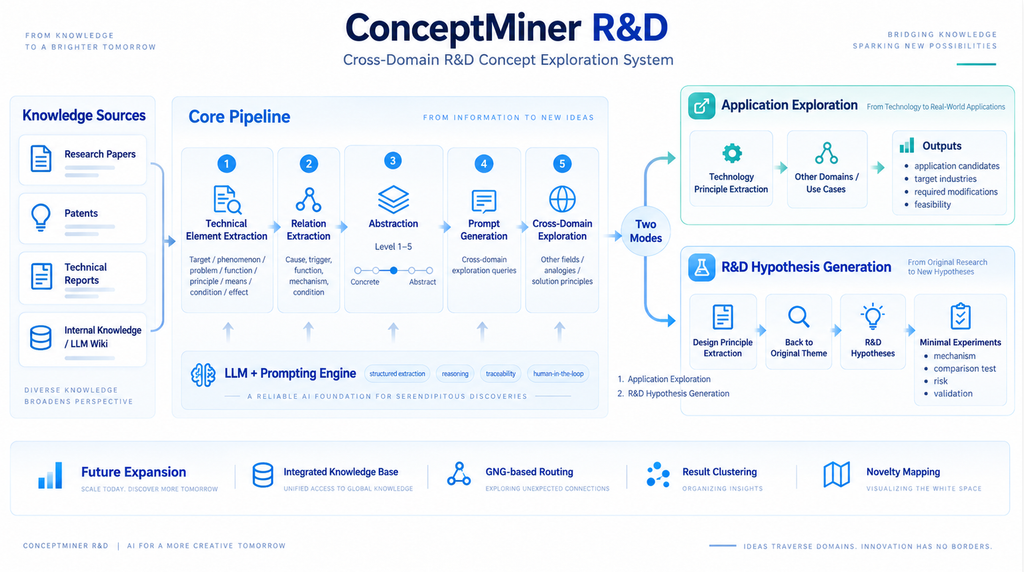
It generates thousands of R&D hypotheses and cross-domain application ideas from technical documents.。
ConceptMiner R&D –Advancing Research and Development through AI
We provide a method for efficiently exploring “what we don’t yet know.” What do you do when you lack keywords or prior knowledge about a topic you haven’t yet discovered? Relying on known keywords limits your information gathering to familiar areas.
The root cause of the problem—“information analysis does not lead to the discovery of new R&D topics”—lies in conducting information searches using known keywords. The Mindware Research Institute has been addressing this challenge for over 25 years. In the 1990s, we attempted to systematize an approach called “conceptual research.” This method involved conceptualizing the characteristics of the topic being sought at a higher level of abstraction and then detecting information that matched those characteristics from a vast amount of data. Unfortunately, this method was heavily dependent on the individual’s skills and abilities.
Today, by leveraging AI, this can be accomplished without the need for special training or significant effort. ConceptMiner R&D is an AI system specialized in exploring R&D themes and generating hypotheses. When you input research papers or technical reports, the AI analyzes them and presents thousands of R&D leads—ideas for research and development—each assigned multiple evaluation scores. You can then use mining tools to scrutinize these results and select hypotheses and ideas that truly resonate with you. This will undoubtedly dramatically accelerate your R&D efforts.
News & Information
- RPA, AI Agents, and Process Mining: Business Automation Is Moving from Execution to Observation and Decision-Making
 Discussions about business automation frequently refer to three technologies: robotic process automation, AI agents, and process mining. These are often introduced as separate categories, but in practice they are not competing technologies. Their relationship can be summarized as follows: In other words, RPA serves as the “hands and feet,” AI agents provide “judgment,” and process…
 - After the AI Bubble Bursts, the Focus Will Shift to Knowledge Mining
 Introduction Discussions of an AI bubble often revolve around a simple question: Is AI real, or is it fake? Yet this question misses the essential nature of a bubble. The same confusion existed during the dot-com bubble around the year 2000. The internet itself was a genuine technological revolution. It did not disappear as a…
 - LLMs Will Become One Component of Practical AI
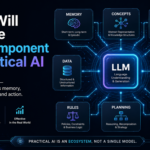 Introduction The emergence of large language models has fundamentally changed public perceptions of artificial intelligence. LLMs can perform question answering, writing, summarization, translation, information organization, programming, and many other tasks through a single natural-language interface—tasks that previously required separate software applications. Because of this extraordinary versatility, a view has begun to spread that AI is…
 - Why RAG Remained So Primitive
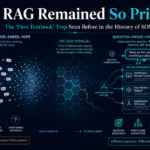 The “First Textbook” Trap Seen Before in the History of SOM Retrieval-Augmented Generation, or RAG, has become widely known as a way to connect generative AI with internal corporate documents. The commonly presented explanation of RAG is surprisingly simple: LangChain’s introductory materials similarly present documents, text splitters, embeddings, vector stores, and retrievers as the basic…
 - What AI Needs to Become a Trustworthy Partner
 The Missing Role of Episodic Memory in Today’s LLMs Generative AI can now perform a wide range of tasks at a remarkably high level, including writing, information organization, programming, research, and business-process automation. Judging from these capabilities alone, it may seem that we are approaching an age in which people can simply delegate work to…