
R&D Exploration Series
Mindware Research Institute
About the SeriesDatasetsExploration ProcessCustom Paper ExplorationCatalogUpcoming Areas
R&D EXPLORATION SERIES / AI-GENERATED TECHNOLOGY HYPOTHESES
AI-Generated Technology Hypotheses at Scale Are
Changing the R&D Competitive Landscape.
AI can now generate large numbers of technical improvement hypotheses and cross-domain application ideas from published research papers—including possibilities that researchers might not ordinarily consider.
R&D Exploration Series offers the results generated by ConceptMiner R&D as paper-specific CSV datasets.
AI-GENERATED HYPOTHESES / INTELLECTUAL PROPERTY
An Era When Published Research Can Lead to Unexpected Technical Improvements.
Research findings are published in papers and patents. Yet even when people have access to the same information, the improvements and applications they envision have traditionally depended on their expertise and experience.
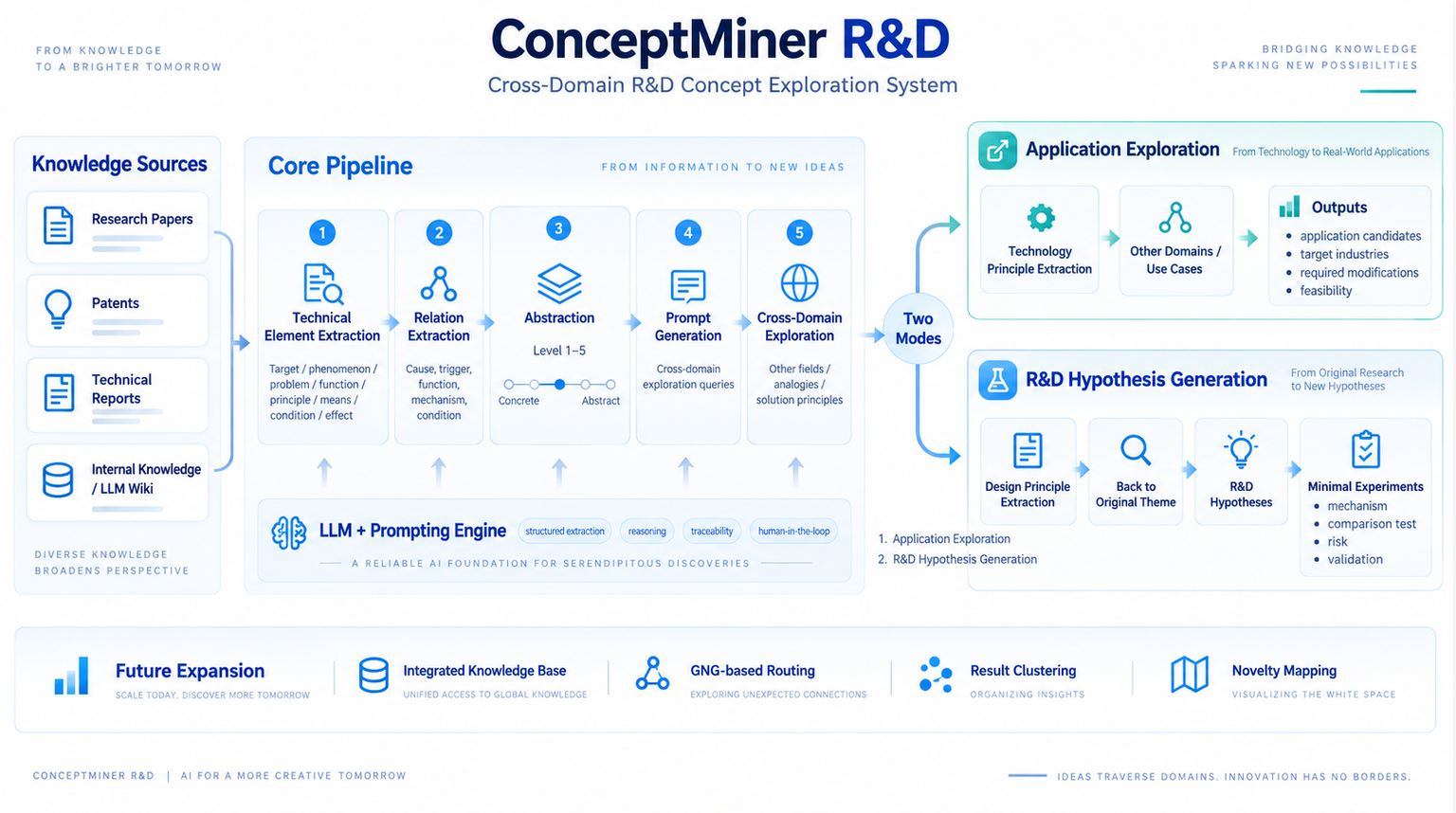
Developed by Mindware Research Institute, ConceptMiner R&D decomposes the technology described in a paper into constituent elements, abstracts their functions, structures, and operating principles, and explores other technical domains. It then brings solution principles from those domains back to the original field to generate numerous improvement hypotheses. It can also work in the opposite direction, exploring new applications for the paper’s technical elements in other industries.
This exploration uses publicly available technical information; it does not rely on confidential sources. As AI expands the scale and scope of technical ideas beyond what individual specialists could traditionally explore, it also raises new questions for established intellectual property strategies.
THREE DATASET SERIES
Three Technology Exploration Dataset Series
01 / R&D HYPOTHESES
R&D Hypotheses
Solutions from other domains → The original research field
Explore solution principles, materials, structures, and mechanisms from other domains to address challenges identified in the source paper, then adapt them into hypotheses for improving or extending the original technology.
Applications: Improving existing technology, defining R&D topics, evaluating technical alternatives
¥100,000 / title · planned price
02 / CROSS-DOMAIN APPLICATIONS
Cross-Domain Applications
Technical elements from the source paper → Applications and challenges in other domains
Abstract the technical elements of the source paper and explore potential uses and challenges in other industries where their functions or characteristics may be valuable.
Applications: New uses for existing technology, market discovery, new product concepts
¥50,000 / title · planned price
03 / EMERGING TECHNOLOGY THEMES
Emerging Technology Themes
Signals of technological and industrial change → Emerging topic candidates
Identify potential R&D topics from advances in technology, standardization, and shifts in industrial structures, without relying on a single source paper.
Applications: Technology scouting, discovering planning topics, identifying future R&D fields
¥20,000–¥30,000 / title · planned price
* Prices are provisional. Final prices, dataset sizes, and fields will be specified for each published title.
HOW HYPOTHESES ARE GENERATED
Decompose a Paper. Explore Other Domains. Generate New Hypotheses.
ConceptMiner R&D does more than search for technology names. Its cross-domain concept exploration abstracts the characteristics and underlying principles of technical elements and uses these similarities to search across different fields. The process below describes how R&D Hypotheses are generated.
01 Extract and Select Technical Elements
Extract technical elements from papers and technical documents, then select promising elements as exploration targets.
02 Abstract and Build Exploration Prompts
Describe each element’s characteristics and functions at multiple levels of abstraction, and construct exploration prompts. The level of abstraction determines how broadly the search proceeds.
03 Explore Solutions in Other Domains
Identify techniques used in other fields and how they work; examine their similarities to and differences from the original technology.
04 Translate into Design Principles
Translate solution principles from other domains into applicable design principles for the original technical field and evaluate them.
05 Generate Development Hypotheses
Generate improvement hypotheses with expected benefits, risks, initial validation approaches, and evaluation criteria such as novelty, feasibility, and impact; organize the output as CSV data.
R&D Hypotheses
Other domains → Original research field. Adapt approaches from other domains to explore improvements and extensions of the original technology.
Cross-Domain Applications
Original technology → Other domains. Evaluate how technical elements could be transferred to new fields, considering target industries, uses, operating principles, necessary modifications, feasibility, and precedents.
For details, see the guide to hypothesis generation and cross-domain applications .
DELIVERABLES
The Main Deliverable Is Structured CSV Data, Not a Lengthy Report.
Receive hypotheses and application ideas in a structured format suitable for searching, sorting, filtering, and internal evaluation. No SaaS subscription or software installation is required.
FROM PUBLIC DATASETS TO IN-HOUSE EXPLORATION
Explore Papers Selected by Your Organization.
Catalog datasets are generated from selected published papers. A separate standardized service using papers specified by customers is also under consideration. This would allow organizations to examine improvement hypotheses derived from cross-domain technologies for research of their own choosing.
Standard generation from a specified paper: proposed starting price of ¥100,000 per paper. The service would focus on a defined exploration process and CSV delivery, rather than custom research reports or outsourced R&D. For confidential materials, appropriate nondisclosure and data-handling terms would apply, with additional security measures quoted separately when needed.
For organizations that later wish to generate hypotheses continuously in-house, implementation projects and on-premises deployment may be considered individually. Purchasing a catalog dataset does not require installing ConceptMiner R&D.
CATALOG / IN PREPARATION
Planned Catalog — 10 Research Papers × 2 Dataset Series
We plan to publish R&D Hypotheses and Cross-Domain Applications datasets based on the ten papers below—two products per paper, or twenty planned titles in total. These are planned releases that have not yet completed generation and quality checks and are not currently available for purchase.
Stripe payment links will be added after each dataset is completed and its content, record count, samples, and terms are confirmed. Once the link is set, “Payment Pending” can be changed to “Buy with Stripe.”
R&D HYPOTHESES · Self-Healing Anticorrosion Materials
Improvement Hypotheses for Self-Healing Anticorrosion Materials
Explore repair, replenishment, and rebonding principles from other domains to address challenges involving dynamic bonds and self-healing mechanisms.
Source paper (2023):In-situ self-crosslinking strategy for autonomous self-healing materials
Product ID: RES-01-HYP
$640.00 Early Price $480.00
CROSS-DOMAIN APPLICATIONS · Self-Healing Anticorrosion Materials
Cross-Domain Applications of Self-Healing Mechanisms
Explore industrial applications for self-healing and dynamic bonding mechanisms originally developed for anticorrosion materials.
Source paper (2023):In-situ self-crosslinking strategy for autonomous self-healing materials
Product ID: RES-01-APP
$320.00 Early Price $240.00
R&D HYPOTHESES · Self-Healing Organic Crystals
Improvement Hypotheses for Self-Healing Optical Crystals
Explore defect-repair principles from other fields to improve damage recovery and maintain optical performance.
Source paper (2023):Autonomous self-healing organic crystals for nonlinear optics
Product ID: RES-02-HYP
$640.00 Early Price $480.00
CROSS-DOMAIN APPLICATIONS · Self-Healing Organic Crystals
Cross-Domain Applications of Self-Healing Organic Crystals
Explore new applications based on autonomous healing and optical response.
Source paper (2023):Autonomous self-healing organic crystals for nonlinear optics
Product ID: RES-02-APP
$320.00 Early Price $240.00
R&D HYPOTHESES · Reversible Underwater Adhesives
Improvement Hypotheses for Reversible Underwater Adhesives
Explore mechanisms from other domains to improve adhesion strength and debonding control under wet conditions.
Source paper (2024):Mussel-inspired thermo-switchable underwater adhesive based on a Janus hydrogel
Product ID: RES-03-HYP
$640.00 Early Price $480.00
CROSS-DOMAIN APPLICATIONS · Reversible Underwater Adhesives
Cross-Domain Applications of Temperature-Responsive Underwater Adhesion
Explore uses for underwater adhesion, temperature control, and reversible debonding in other products and processes.
Source paper (2024):Mussel-inspired thermo-switchable underwater adhesive based on a Janus hydrogel
Product ID: RES-03-APP
$320.00 Early Price $240.00
R&D HYPOTHESES · Passive Thermal Control Films
Improvement Hypotheses for Passive Thermal Control Films
Explore principles from other domains to improve thermal control combining radiative cooling with moisture adsorption and desorption.
Source paper (2024):Passive isothermal film with self-switchable radiative cooling-driven water sorption layer
Product ID: RES-04-HYP
$640.00 Early Price $480.00
CROSS-DOMAIN APPLICATIONS · Passive Thermal Control Films
Cross-Domain Applications of Power-Free Thermal Control
Apply radiative cooling, adsorption/desorption, and autonomous switching to other thermal-management challenges.
Source paper (2024):Passive isothermal film with self-switchable radiative cooling-driven water sorption layer
Product ID: RES-04-APP
$320.00 Early Price $240.00
R&D HYPOTHESES · Atmospheric Water Harvesting Materials
Improvement Hypotheses for Atmospheric Water Harvesting Materials
Explore principles of water transport and energy use from other fields to improve moisture uptake, release, and collection cycles.
Source paper (2024):Enhanced continuous atmospheric water harvesting with scalable hygroscopic gel
Product ID: RES-05-HYP
$640.00 Early Price $480.00
CROSS-DOMAIN APPLICATIONS · Atmospheric Water Harvesting Materials
Cross-Domain Applications of Atmospheric Water Harvesting
Explore the use of hygroscopic gels and continuous collection mechanisms in dehumidification, separation, and resource recovery.
Source paper (2024):Enhanced continuous atmospheric water harvesting with scalable hygroscopic gel
Product ID: RES-05-APP
$320.00 Early Price $240.00
R&D HYPOTHESES · Ultra-Thin Soft Robots
Improvement Hypotheses for Ultra-Thin Soft Robots
Explore deformation and propulsion principles from other fields to improve motion in confined spaces and switching between locomotion modes.
Source paper (2024):Multimodal locomotion ultra-thin soft robots for exploration of narrow spaces
Product ID: RES-06-HYP
$640.00 Early Price $480.00
CROSS-DOMAIN APPLICATIONS · Ultra-Thin Soft Robots
Cross-Domain Applications of Ultra-Thin Soft Robots
Explore uses for ultra-thin structures, deformation, and locomotion in inspection, maintenance, medical devices, and other fields.
Source paper (2024):Multimodal locomotion ultra-thin soft robots for exploration of narrow spaces
Product ID: RES-06-APP
$320.00 Early Price $240.00
R&D HYPOTHESES · Nanoporous Ion-Selective Membranes
Improvement Hypotheses for Ion-Selective Membranes
Explore separation and transport principles from other fields to improve selectivity, permeability, and durability.
Source paper (2024):In situ generation of (sub) nanometer pores in MoS₂ membranes for ion-selective transport
Product ID: RES-07-HYP
$640.00 Early Price $480.00
CROSS-DOMAIN APPLICATIONS · Nanoporous Ion-Selective Membranes
Cross-Domain Applications of Selective Nanopore Transport
Explore selective ion transport in separation, recovery, and device applications beyond water treatment.
Source paper (2024):In situ generation of (sub) nanometer pores in MoS₂ membranes for ion-selective transport
Product ID: RES-07-APP
$320.00 Early Price $240.00
R&D HYPOTHESES · CO₂-Enabled Recyclable Polymers
Improvement Hypotheses for CO₂-Enabled Recyclable Polymers
Explore reaction-control methods from other domains to reconcile bond switching during recycling with material performance.
Source paper (2024):Covalent adaptable polymer networks with CO₂-facilitated recyclability
Product ID: RES-08-HYP
$640.00 Early Price $480.00
CROSS-DOMAIN APPLICATIONS · CO₂-Enabled Recyclable Polymers
Cross-Domain Applications of CO₂-Responsive Polymers
Apply CO₂-controlled bonding and network reconfiguration to a wider range of product designs.
Source paper (2024):Covalent adaptable polymer networks with CO₂-facilitated recyclability
Product ID: RES-08-APP
$320.00 Early Price $240.00
R&D HYPOTHESES · Sodium–Air Batteries
Improvement Hypotheses for Reversible Carbonate-Reaction Batteries
Explore other-domain principles to improve reaction reversibility, stability, and electrode/electrolyte design.
Source paper (2024):Activating reversible carbonate reactions in Nasicon solid electrolyte-based Na-air battery
Product ID: RES-09-HYP
$640.00 Early Price $480.00
CROSS-DOMAIN APPLICATIONS · Sodium–Air Batteries
Cross-Domain Applications of Reversible Carbonate Reactions
Explore reversible use of carbonate reactions, often treated as side reactions, in other devices and processes.
Source paper (2024):Activating reversible carbonate reactions in Nasicon solid electrolyte-based Na-air battery
Product ID: RES-09-APP
$320.00 Early Price $240.00
R&D HYPOTHESES · Structural Color Films
Improvement Hypotheses for Structural Color Film Manufacturing
Explore manufacturing principles from other domains to improve structural color formation, shear processing, durability, and scalability.
Source paper (2024):Scalable production of structurally colored composite films by shearing supramolecular composites
Product ID: RES-10-HYP
$640.00 Early Price $480.00
CROSS-DOMAIN APPLICATIONS · Structural Color Films
Cross-Domain Applications of Structural Color Films
Explore optical, sensing, display, and other applications of structural coloration and shear-based forming.
Source paper (2024):Scalable production of structurally colored composite films by shearing supramolecular composites
Product ID: RES-10-APP
$320.00 Early Price $240.00
* Product titles describe planned exploration based on published papers; they do not imply collaboration with or endorsement by the papers’ authors. Prices are provisional (tax treatment will be confirmed before launch). Contents will be finalized upon publication.
FORTHCOMING AREAS
Other Planned Fields and Topics
Beyond materials and chemistry, future titles may cover electronics, mechanical engineering, manufacturing, medical devices, energy, and related fields. The areas below are candidates; release order, timing, and contents have not been determined.
Semiconductors and Electronic Devices
Advanced packaging, chiplets, power semiconductors, thermal management, next-generation sensors, photonic–electronic integration
Power and Energy
Next-generation energy storage, power conversion, distributed generation, waste heat, energy harvesting
Mechanical Engineering and Robotics
Novel actuators, soft robotics, reconfigurable mechanisms, confined-space operations, autonomous mobility
Manufacturing and Quality Control
Low-energy processing, noncontact manufacturing, process monitoring, defect prediction, self-adjusting production
Medical and Healthcare Devices
Minimally invasive devices, diagnostic sensors, drug delivery, biomimetics
Communications and Photonics
Photonic integrated circuits, optical sensing, low-power communications, next-generation photonics
Agriculture and Food
Precision fermentation, nondestructive quality evaluation, freshness preservation, environmental control, food-processing technologies
Environment and Circular Resources
Selective resource recovery, separation membranes, CO₂ utilization, low-energy processing, circular manufacturing
Mobility and Transportation
Lightweight structures, thermal management, electrification, safety controls, maintenance technologies
Buildings and Infrastructure
Structural monitoring, deterioration diagnostics, self-healing, passive cooling, extended service life
Emerging Technology Themes — Technology Scouting
Instead of specifying a source paper, this series sets exploration conditions such as value delivered by a technology, development stage, diffusion patterns, and industry sector. AI gathers supporting information and produces an evidence CSV and topic candidates grouped by common characteristics.the guide to technology theme exploration
Unlike paper-specific datasets, Emerging Technology Themes combines signals from research, standardization, the removal of technical constraints, and changes in industrial structures. We plan to test multiple exploration patterns and release topic-based CSV datasets progressively.
Planned price: ¥20,000–¥30,000 per title. Specific titles and payment links will be added as the series is published.
IMPORTANT INFORMATION
Before You Purchase
This series consists of technical hypotheses and application ideas generated through AI-assisted concept exploration of publicly available technical information. The contents are not proposals made or endorsed by the authors of the source papers.
This product does not convey patent rights or ownership of inventions. Purchasing a dataset does not grant exclusive ownership of the individual ideas it contains. The same dataset may be purchased by other companies or research institutions.
This product does not guarantee the validity of existing patents or freedom from infringement of third-party intellectual property rights. Not every hypothesis has been verified for technical feasibility, novelty, inventive step, or commercial viability. Nor does a cited source paper establish that a generated hypothesis has been experimentally demonstrated.
This series is not a substitute for patent searches or legal opinions on intellectual property. It provides information for evaluating alternative technical directions in R&D.
How Many Technical Alternatives Can Emerge from a Single Published Paper?
R&D Exploration Series provides AI-generated improvement hypotheses and cross-domain application ideas in paper-specific CSV datasets.