
Kunihiro Tada, CEO of Mindware Research Institute
12 Oct 2026
Must AI Evolve Simply by Shrinking Large Language Models?
The development of generative AI has been driven primarily by improvements in large language models (LLMs) based on the Transformer architecture. Trained on enormous amounts of text, these models can communicate with humans in natural language and are transforming knowledge-intensive work. However, as AI applications expand into robotics, manufacturing equipment, mobile devices, and other physical systems, new architectural possibilities are emerging that do not necessarily place natural language generation at the center of intelligence.
Much of today’s edge AI development focuses on reducing the size of large models through techniques such as distillation and quantization, enabling them to operate within limited computational resources. While this is a practical approach, a more fundamental question deserves consideration: Does edge AI actually need the same capabilities as a large language model?
For example, an industrial robot may benefit more from recognizing its operating environment, recalling relevant experiences, and selecting appropriate actions than from possessing extensive encyclopedic knowledge or generating fluent explanations. It may need to detect subtle changes in equipment conditions, associate them with previously encountered anomalies, and determine an appropriate response. Such intelligence might be implemented without relying primarily on natural language generation.
Future AI systems may therefore evolve not only toward increasingly powerful unified models but also toward architectures in which specialized models perform different cognitive functions and cooperate with one another.
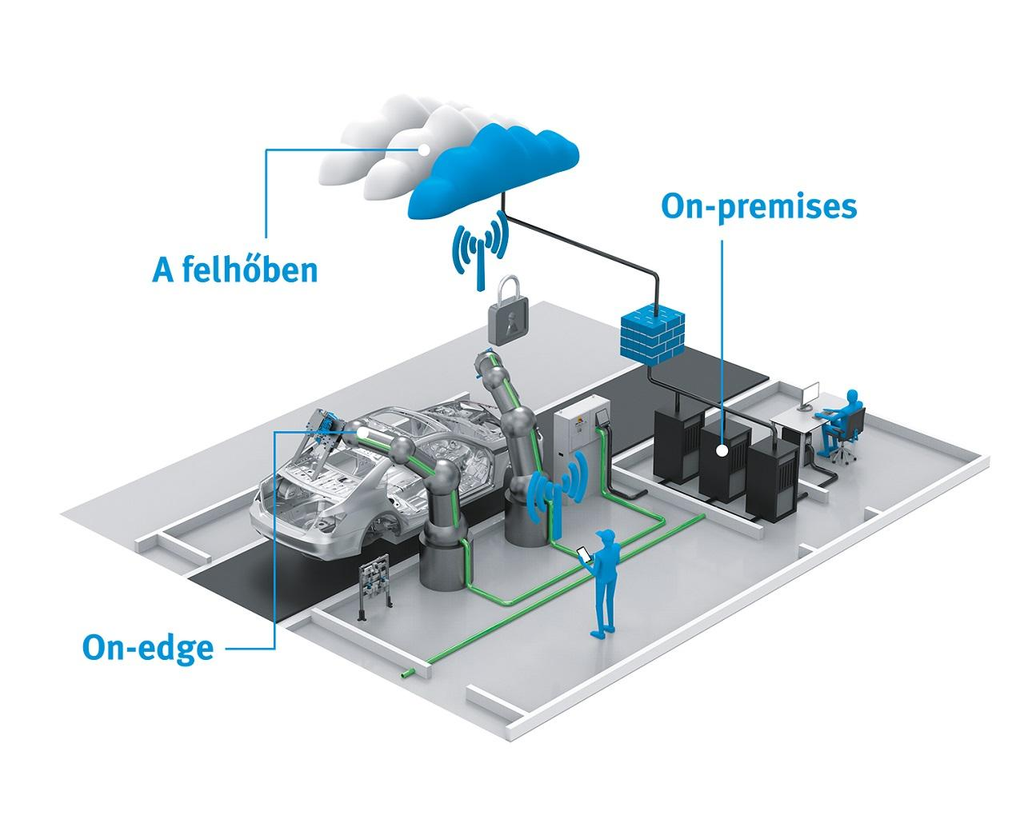
A central cloud model provides general knowledge and advanced reasoning, while robots and industrial equipment maintain their own individual memories. Bidirectional arrows illustrate knowledge acquisition and the sharing of locally acquired experiences.
Reconsidering Associative Memory Architectures
From this perspective, neural architectures based on associative memory deserve renewed attention.
The fundamental idea of associative memory is to retrieve stored information related to an input. In Key-Value associative memory, a query vector is compared with stored keys, and corresponding values are retrieved according to similarity. Multiple memories can also be combined through weighted retrieval.
Memory Mosaics, presented at ICLR 2025, proposed an architecture that combines multiple associative memories to support contextual learning and the composition of information. Subsequent research scaled the approach to 10 billion parameters and reported results exceeding those of Transformer baselines under certain evaluation conditions.
Meanwhile, Google Research’s Titans and MIRAS investigate mechanisms for incorporating new information into memory during inference. Although these approaches differ technically, they share an interest in integrating long-term memory and adaptation more directly into AI architectures rather than relying exclusively on conventional attention mechanisms.
However, Memory Mosaics has primarily been evaluated as a language modeling architecture. Its suitability for small, energy-efficient local AI systems has not yet been established. The broader significance of this research is not that a particular solution has already been completed, but that architectures treating memory as a fundamental component of intelligence remain an active and promising area of investigation.
Non-Linguistic and Restricted-Language Models
AI does not necessarily need to translate every perception, prediction, or decision into natural language.
Humans do not verbally describe every step involved in walking, manipulating objects, or performing skilled tasks. Much of human behavior relies on perceptions of shape, position, movement, and accumulated experience without explicit verbal reasoning.
Similarly, AI systems can transform sensor data and images into feature vectors, recognize states within those representations, and predict future conditions. Meta’s V-JEPA 2 provides an example of research using representations learned from video to understand and predict physical-world dynamics and support robotic planning. Its significance lies in modeling the physical world through predictions in latent representation spaces rather than through natural language generation.
Another possibility is to restrict a model’s inputs and outputs to specific structured formats. For example, a system could receive equipment-state data and return anomaly probabilities, possible causes, and recommended actions. A separate LLM could generate natural language explanations only when necessary.
It is important to distinguish non-linguistic models from associative memory models. Non-linguistic prediction systems may still use Transformers, while associative memory architectures can also process language. The essential opportunity is to select suitable architectures for distinct functions such as language generation, experience storage, state prediction, and action selection.
Rather than shrinking a general-purpose language model to fit every device, it may be more effective to design local intelligence around the actual cognitive requirements of each application.
Local AI That Accumulates Individual Experience
Traditional machine learning often involves collecting data from multiple devices or users, training a common model, and distributing that model to individual systems. However, real-world robots and industrial equipment differ in their operating environments, mechanical characteristics, usage histories, and patterns of deterioration.
It may not be efficient or necessary for a centralized model to learn every detail of every individual device.
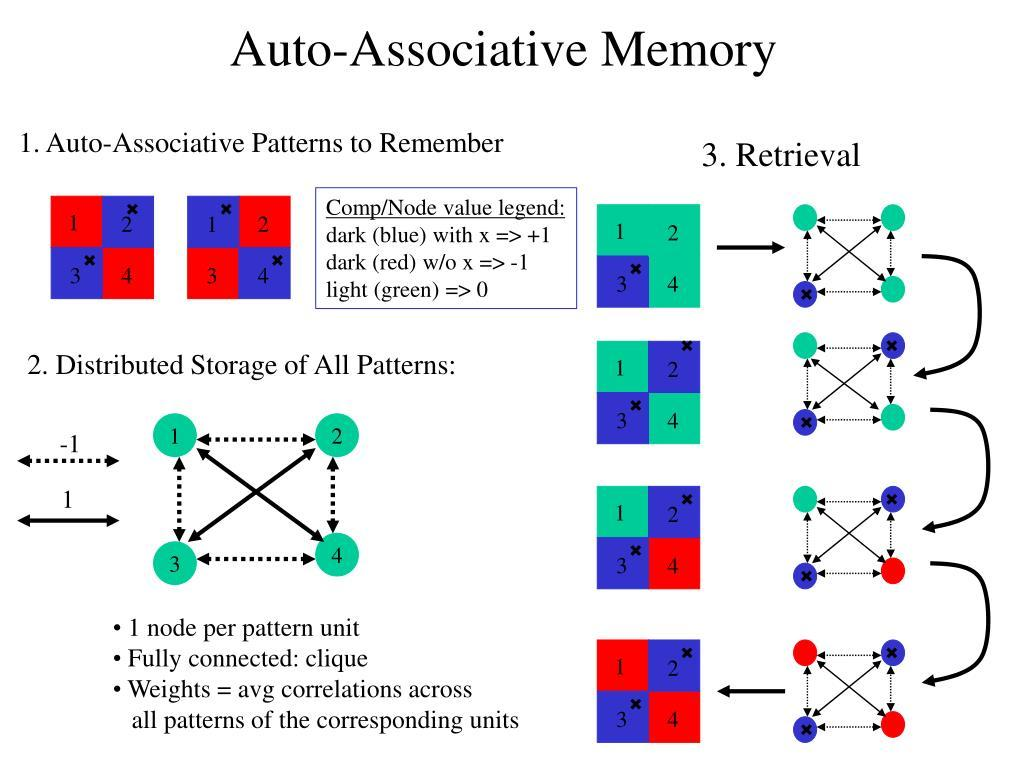
Future local AI systems may instead need mechanisms for remembering individual experiences, retrieving similar past situations, and updating concepts and patterns learned from accumulated observations.
Consider industrial equipment that continuously records vibration, temperature, load, operating conditions, control actions, and quality outcomes. These observations could be organized into representative operating-state patterns. When a malfunction occurs, the system could associate the event with changes observed beforehand. If similar patterns emerge later, it could retrieve relevant experiences and identify potential responses.
This requires at least two complementary forms of memory: episodic memory, which records individual events and their circumstances, and conceptual or semantic memory, which captures recurring patterns across multiple experiences.
Prototype-learning techniques such as Growing Neural Gas (GNG) and vector quantization are potential approaches for organizing continuous, high-dimensional observations into representative states. By associating these states with experiences, outcomes, and transitions, a system could connect concept formation with associative memory.
Nevertheless, retrieving similar experiences does not automatically produce appropriate actions. Predictive models, decision mechanisms, safety constraints, and validation procedures may also be required. In safety-critical equipment and robotics, learned recommendations must not be allowed to bypass established control and safety mechanisms.
The larger research challenge is therefore not simply to store more experiences, but to determine how experience can be converted into useful knowledge and reliably applied to new situations.
The diagram illustrates the process: sensor input → feature vectors → concept formation using GNG → retrieval of similar experiences → state prediction and decision-making. A feedback loop shows how new experiences update the memory system.
A Network of Cooperating Large Models and Individual AI Systems
Google DeepMind has been developing the Gemini Robotics On-Device family, demonstrating the growing importance of models capable of operating locally on robots. Current robotics AI development, however, also emphasizes the optimization of models that integrate language, vision, and action.
An alternative direction is an architecture in which large centralized models provide general knowledge and advanced reasoning, while local models maintain individual memories and perform routine perception, prediction, and decision-making.
Under this arrangement, local AI systems would normally operate independently of continuous network access. When encountering unfamiliar situations beyond their existing knowledge, they could request additional information or reasoning from a larger model.
The information flow could also work in the opposite direction. When an individual robot or device discovers a potentially useful pattern through experience, it could share that finding with a central system. The central system could compare observations from multiple devices, evaluate their reliability, identify generalizable knowledge, and distribute validated findings to other local systems.
Not every raw observation would need to be uploaded. Devices might instead exchange learned features, concepts, state transitions, unusual events, or other structured representations.
Such a system would resemble a distributed knowledge network in which individual AI systems accumulate experience locally while contributing to collective learning.
Several difficult questions remain unresolved. How can concepts independently formed by different devices be aligned? How can a system distinguish generalizable knowledge from environment-specific observations? How can incorrect experiences be prevented from spreading? How can updates be validated without compromising the safety or stability of individual devices?
Existing research in federated learning, continual learning, knowledge distillation, and distributed AI provides partial foundations, but an integrated architecture for long-term, experience-based collective learning remains an open research problem.
If these challenges can be addressed, AI networks may evolve beyond the conventional arrangement of centrally trained models distributed to passive endpoints. Individual systems could become active participants in the creation, refinement, and exchange of knowledge.
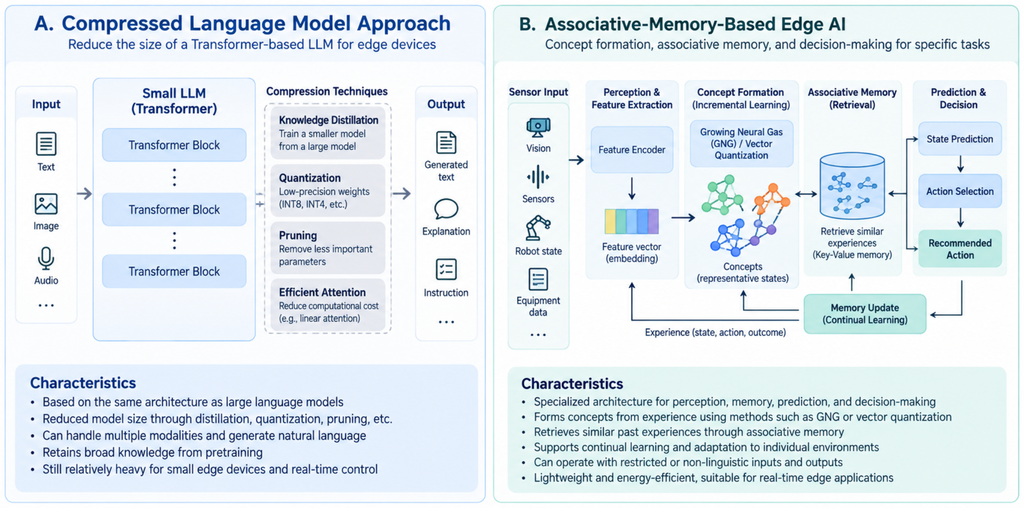
The left side depicts the conventional approach of compressing or distilling Transformer-based models. The right side presents an alternative architecture combining concept formation, associative memory, and specialized decision-making mechanisms.
Opportunities for Japanese Industrial Technology
If future AI development were determined exclusively by the scale of language models, companies and countries with access to enormous computing resources and investment capital would retain substantial advantages. However, the direction of AI architecture is not yet settled.
For intelligent robots and industrial equipment, capabilities such as continual learning, adaptation to individual environments, low latency, energy efficiency, and operational reliability may be more important than extensive language generation capabilities.
Japan has substantial industrial capabilities in robotics, precision machinery, machine tools, production equipment, and sensor technologies. These fields provide practical environments in which AI can encounter physical processes, observe changing conditions, and learn from operational experience.
If such industrial expertise can be connected with new architectures for memory, concept formation, and adaptive decision-making, opportunities may emerge that differ significantly from competition in general-purpose language models.
Nevertheless, an established industrial base does not automatically translate into leadership in AI architectures. Progress will require access to real-world experimental environments, continuous operational data, sophisticated software engineering, reliable evaluation methods, and cooperation between industrial companies and AI researchers.
The objective should not necessarily be to compete directly with the largest foundation models. It should be to identify important industrial problems that those models do not adequately solve and develop architectures suited to those problems.
In particular, AI systems capable of forming concepts from experience, maintaining individual memories, and adapting to changing physical environments may represent an important research opportunity.
Toward the Integration of Concept Formation and Associative Memory
At Mindware Research Institute, our research on ConceptMiner focuses on forming conceptual structures from high-dimensional data and analyzing similarities and relationships within those structures.
Our current system, ConceptMiner R&D, extracts technical features and elements from scientific and technological information, explores knowledge across disciplinary boundaries, and supports the generation and analysis of R&D hypotheses. Future applications are being considered in areas including Strategy, Marketing, Quality, and Production.
Although these fields involve different types of information and different analytical objectives, they may share a common technological foundation: forming concepts from data, analyzing relationships among concepts, and matching new information against previously established conceptual structures.
Quality and Production applications are particularly relevant to the longer-term possibility of experience-based AI. Manufacturing processes generate continuous observations of changing operating conditions, actions, anomalies, and outcomes. Learning the relationships among these observations could provide a foundation for systems that accumulate and apply individual experience.
Extending these capabilities may eventually lead toward local AI architectures integrating concept formation, associative memory, and continual learning.
ConceptMiner does not currently provide a general-purpose associative-memory AI architecture or an autonomous robotic control system. These possibilities represent longer-term research directions rather than existing product capabilities.
The underlying research question, however, is fundamental:
The future of AI may depend not only on how much knowledge a model acquires during training, but also on how effectively it can remember new experiences, generalize them into concepts, and apply those concepts to subsequent decisions.
Large Transformer-based models will undoubtedly continue to evolve. Alongside them, however, edge AI architectures emphasizing associative memory, concept formation, state prediction, and continual learning may develop into an increasingly important field.
The architecture of artificial intelligence is far from settled.
References
- Zhang, J. et al. (2025). Memory Mosaics. ICLR 2025. https://arxiv.org/abs/2405.06394
- Zhang, J. & Bottou, L. (2025). Memory Mosaics at Scale. NeurIPS 2025. https://arxiv.org/abs/2507.03285
- Behrouz, A. et al. (2025). Titans: Learning to Memorize at Test Time. https://arxiv.org/abs/2501.00663
- Assran, M. et al. (2025). V-JEPA 2: Self-Supervised Video Models Enable Understanding, Prediction and Planning. https://arxiv.org/abs/2506.09985
- Google DeepMind (2025). Gemini Robotics On-Device Brings AI to Local Robotic Devices. https://deepmind.google/blog/gemini-robotics-on-device-brings-ai-to-local-robotic-devices/
- Google Research (2025). Titans + MIRAS: Helping AI Have Long-Term Memory. https://research.google/blog/titans-miras-helping-ai-have-long-term-memory/